
In today’s data-driven landscape, it’s easy to believe that if you buy the right technology platform or hire enough skilled data engineers, your Data Governance headaches will vanish.
Many enterprise organizations fall directly into this trap—pouring capital into modern data stacks, shiny data catalogs, automated pipelines, and cloud observability tools, assuming that good engineering equals good governance.
Here is the operational reality: technology alone does not solve data governance. People and processes do [DAMA International, DMBOK2].
Without clear business roles, explicit domain accountability, and a culture of data stewardship, even the most expensive technology stack will fail to deliver trusted, compliant analytics [Gartner, Data Governance Framework].
The Tech Mirage: Why Organizations Fall Into the Tooling Trap
Why do executive leaders continuously fall for the promise of "push-button" data governance?
- Data Quality Crisis
- Purchase Expensive Software
- Low Business Adoption
- Persistent Data Chaos
Several systemic factors tempt organizations toward technology-first solutions:
- Rapid Innovation in Data Engineering: The explosive evolution of cloud data warehouses, vector stores, and automated ELT pipelines creates the illusion that software can automate away organizational friction.
- Vendor Over-Promising: Software vendors frequently market platforms with promises of "built-in governance" or "AI-driven automated cataloging," obscuring the human work required to define business rules.
- The Comfort Zone of Technical Teams: Engineering and IT teams naturally feel more comfortable solving technical, code-based problems than navigating complex, cross-departmental politics and behavioral change.
- The Perception of Bureaucracy: Governance is often mischaracterized as slow, restrictive red tape. Executive leaders naturally hope technology can bypass the hard work of organizational alignment.
Governance is not a software package you install. It is an operating framework of principles, policies, explicit accountabilities, and human behaviors designed to protect data quality, privacy, and commercial utility [ED Council, DCAM v2]. You cannot code human accountability into existence.
What Technology Does Well—and Where It Stops
To be clear, modern data platforms are indispensable. They provide the automated infrastructure required to scale data operations across global enterprises.
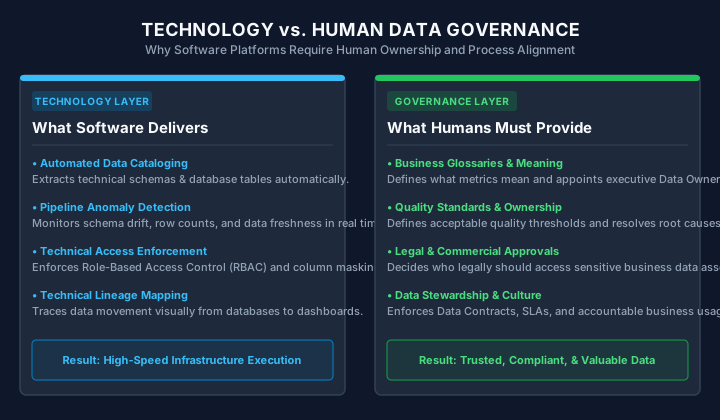
| Capability Dimension | What Technology Delivers (Software Layer) | What Humans & Culture Must Provide (Governance Layer) |
|---|---|---|
| Data Cataloging | Automatically crawls databases and extracts technical metadata schemas. | Assigns named Data Owners, defines business metrics, and validates context. |
| Data Quality | Runs automated anomaly detection and tracks schema drift in real time. | Defines what "acceptable quality" means and takes ownership of fixing root causes. |
| Access Control | Enforces Role-Based Access Control (RBAC) and column-level masking. | Decides who should legally and commercially have access to sensitive records. |
| Data Lineage | Visually maps pipeline dependencies from source tables to dashboards. | Establishes domain contracts, SLAs, and cross-functional accountability when pipelines break. |
A shiny catalog is useless if business analysts don't trust its definitions. An automated observability pipeline won't prevent poor manual data entry at the point of customer onboarding. A quality monitoring dashboard means nothing if no named Data Steward owns the follow-up remediation.
Data Governance Is a Human Problem
Sustainable governance is built on human organizational foundations:
- Clear Domain Roles: Who owns customer data? Who stewards financial metrics day-to-day? Who decides when a dataset is fit for production?
- Agreed Business Standards: How does the enterprise define "Active Customer"? What baseline accuracy is required for executive reporting? How is PII classified?
- Enforceable Accountability: Who is held accountable when a data failure impacts revenue or triggers an audit penalty?
- A Culture of Stewardship: Do employees treat data as a shared corporate asset, or do they hoard spreadsheet copies in departmental silos?
The Price of Ignoring the Human Layer
Companies that rely solely on technology to solve governance challenges consistently experience predictable failure modes:
- Low Platform Adoption: The organization spends $200,000+ on an enterprise catalog, but six months later, business teams still rely on ungoverned, local spreadsheets.
- Alert Fatigue: Automated quality tools trigger thousands of unmonitored anomaly alerts that engineering teams systematically ignore because no business owner prioritizes fixing them.
- Persistent "Versions of the Truth": Automated pipelines run perfectly, yet executive board meetings stall because Sales, Marketing, and Finance present conflicting KPI figures.
- Compliance Exposure: Sensitive PII leaks into unmonitored development environments because technical access rules were configured without legal or business input.
Practical Roadmap: Balancing People, Process, and Technology
To build a balanced, high-impact governance capability, follow this structured execution plan [TDWI, Analytics Maturity Model]:
- Start with Business Outcomes, Not Tool Demos: Define the specific operational friction or financial risk you need to resolve before evaluating software vendors.
- Formally Appoint Business Owners: Name executive Data Owners and operational Data Stewards in business units before deploying catalogs or mesh platforms.
- Establish a Unified Business Glossary: Work with cross-functional leaders to agree on common definitions for core enterprise metrics before building new dashboards.
- Use Technology as an Enforcer, Not a Strategy: Implement software tools to automate, scale, and monitor the governance rules previously agreed upon by your people.
- Invest in Enterprise Data Literacy: Train business users on data ethics, privacy responsibilities, and certified self-service workflows.
Conclusion
Technology is a powerful accelerator, but it accelerates whatever environment you already have. If you layer modern technology over chaotic, unaccountable human processes, you simply get automated, high-speed chaos.
Data Governance is human work, powered by clear principles, structured processes, and an organizational culture of responsibility. When you align your teams and empower your people first, technology finally fulfills its promise as a true strategic enabler.
Ready to Evaluate Your Data Governance Foundation?
Is your organization struggling with low tool adoption or persistent data quality issues despite heavy technology investments? Take our quick diagnostic assessment to benchmark your maturity across People, Process, Technology, and Data, and receive a customized improvement roadmap.