
Feeling lost on your enterprise Data Governance journey?
Implementing data governance without a structured framework is like setting off on a long journey without a map: you spin in circles, miss critical operational checkpoints, and risk wasting valuable budget and engineering capacity. A governance framework acts as a foundational blueprint that defines key roles, responsibilities, decision rights, and technical workflows. It provides the scaffolding needed to turn fragmented, chaotic data operations into a reliable corporate asset [DAMA International, DMBOK2].
Rather than adding bureaucratic red tape, a well-chosen framework aligns technical data management with C-suite commercial strategy [Gartner, Data Governance Framework].
Whether you are starting from scratch or refining an existing program, selecting or combining the right frameworks brings clarity, accountability, and sustainable momentum to your initiatives.
What Is a Governance Framework and Why Does It Matter?
A data governance framework defines how data is managed, who is explicitly responsible for its quality and security, and how information-related decisions are made across business domains.
BUSINESS STRATEGY ALIGNMENT
Links data quality goals directly to enterprise ROI, risk, and compliance.
EXPLICIT ACCOUNTABILITY & ROLES
Assigns named Data Owners, Data Stewards, and technical custodians.
ENFORCEABLE OPERATIONAL PROCESSES
Standardizes data glossaries, lineage tracking, and automated quality checks.
Without a framework, governance efforts devolve into isolated, reactive firefighting. A structured framework ensures that essential steps—such as metadata cataloging, data privacy enforcement, and domain stewardship—are executed systematically and at the right time [ED Council, DCAM v2].
2-Step Practical Tool: The 5W2H Governance Canvas
For organizations seeking a lightweight, agile starting point, the 5W2H Canvas breaks complex governance mandates into seven actionable, pragmatic dimensions:
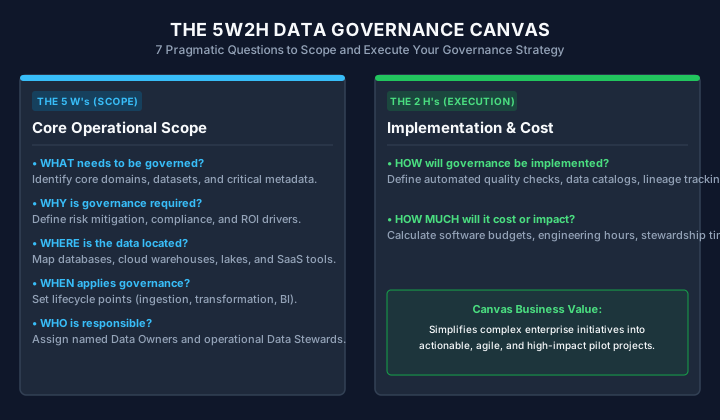
- What: What specific datasets, domains, or metadata layers need to be governed? (e.g., Customer Master Data, Financial Ledgers).
- Why: Why is governance needed for this specific asset? (e.g., Regulatory compliance, AI model accuracy, eliminating dashboard inconsistencies).
- Where: Where does this data reside across the tech stack? (e.g., Cloud warehouses, legacy mainframes, SaaS platforms).
- When: When in the data lifecycle should governance guardrails be applied? (e.g., At ingestion points, during ETL transformation, or before BI publication).
- Who: Who is accountable for this domain? (Designated executive Data Owners and operational Data Stewards).
- How: How will governance rules be implemented and enforced? (e.g., Automated quality checks, data contracts, role-based access control).
- How Much: What is the required financial budget, engineering effort, and expected business impact?
Practical Application: The 5W2H Canvas is ideal for conducting initial scope workshops, building Minimum Viable Products (MVPs), or gaining fast C-suite alignment without overwhelming business stakeholders.
Comparing Leading Enterprise Governance Frameworks
Depending on your organization's scale, regulatory environment, and analytical maturity, different established frameworks offer tailored methodologies:
| Governance Framework | Core Operational Philosophy | Primary Focus & Strengths | Best Fit / Ideal Organization |
|---|---|---|---|
| DAMA-DMBOK2 | Comprehensive Data Management Body of Knowledge. | Covers 11 core knowledge areas (Data Architecture, Quality, Metadata, Security, Storage). | Organizations seeking an exhaustive, standardized industry benchmark across all data management domains. |
| DGI Framework (Data Governance Institute) | Focuses on decision rights, rules, and accountabilities. | Highly structured taxonomy defining governance drivers, decision rights, and control processes. | Enterprises needing a formal, policy-driven framework with clear regulatory compliance controls. |
| Non-Invasive Governance (Robert S. Seiner) | Formalizes existing responsibilities without imposing new titles. | Minimizes operational disruption by recognizing implicit data stewards and formalizing daily workflows. | Companies with rigid corporate cultures or low appetite for bureaucratic organizational changes. |
| IBM Unified Process | Structured 14-step implementation process. | Step-by-step roadmap linking maturity assessments, executive sponsorship, and operational roadmaps. | Large enterprises looking for a top-down, phased implementation methodology tied to large software stacks. |
| Active / Collaborative Governance (e.g., Alation, Atlan) | Modern, people-first, and technology-aligned. | Embeds governance directly into daily user workflows using intelligent catalogs, automation, and crowdsourcing. | Agile, tech-forward companies prioritizing self-service analytics, data mesh, and high user adoption. |
| Progressive Governance (e.g., OvalEdge) | Iterative, technology-aligned growth. | Scales governance capabilities progressively alongside technological adoption, cloud expansion, and AI use cases. | Organizations seeking an evolving model that grows incrementally with cloud and AI maturity. |
Decision Matrix: Choosing the Right Framework Mix
Organizations are not locked into choosing a single framework in isolation. High-performing data teams frequently combine the structural depth of DAMA-DMBOK2 with the operational agility of Non-Invasive Governance or the 5W2H Canvas.
When evaluating your framework strategy, assess four critical organizational criteria [TDWI, Analytics Maturity Model]:
- Low / Initial
- Start with 5W2H Canvas or Non-Invasive Governance
- High / Advanced
- Adopt DAMA-DMBOK2, DGI, or IBM Unified Process
- Collaborative / Agile
- Active / Collaborative Governance Frameworks
- Formal / Hierarchical
- DGI or IBM Unified Process
- Single Domain / Departmental
- Lightweight Canvas / Non-Invasive
- Global / Multi-Domain
- DAMA-DMBOK2 / Data Mesh Federated Governance
- High (Banking, Healthcare, Insurance)
- DGI / DAMA-DMBOK2 / IBM
- Moderate (E-Commerce, Tech)
- Active / Collaborative / Progressive
Actionable Steps to Roll Out Your Framework
To ensure your chosen framework delivers commercial value rather than becoming unused documentation, follow this implementation roadmap:
- Conduct a Maturity Assessment: Benchmark your current capabilities across People, Process, Technology, and Data to identify critical gaps.
- Define Immediate Scope using the 5W2H Canvas: Focus initial governance efforts on a single, high-impact business value stream (e.g., Customer Master Data or Financial Reporting).
- Appoint Domain Accountabilities: Formally name executive Data Owners and operational Data Stewards within business units.
- Deploy Supporting Tooling: Implement a governed data catalog to automate metadata collection, lineage tracking, and business glossary publishing.
- Establish Iterative Measurement Cycles: Track operational KPIs—such as data defect reduction, report duplication rates, and catalog adoption—to demonstrate continuous ROI.
Ready to Evaluate Your Data Governance Foundation?
Are you unsure which framework fits your organization's current maturity level? Take our quick diagnostic assessment to evaluate your capabilities across People, Process, Technology, and Data, and receive a customized improvement roadmap.