
Is your organization drowning in contradictory executive dashboards and fragmented data lakes?
Over the last three decades, enterprise data usage has undergone a massive transformation. What began as basic, backend record-keeping has evolved into complex, real-time analytics ecosystems driving daily business decisions. However, because most organizations expanded their analytics capabilities at a breakneck pace—without establishing structural rules, quality controls, or domain accountability—this rapid growth created a critical bottleneck: Data Chaos [DAMA International, DMBOK2].
Today, executive teams find themselves managing a paradox: having access to petabytes of business data, yet struggling to find a single, trustworthy metrics report.
Transitioning from chaotic analytics to scalable, trusted intelligence requires embracing formal Data Governance—the operational framework that structures, secures, and optimizes enterprise information assets [Gartner, Data Governance Framework].
The 4-Stage Evolution of Enterprise Data
To understand why data governance has become an urgent executive priority, we must examine how enterprise data maturity evolved over time:
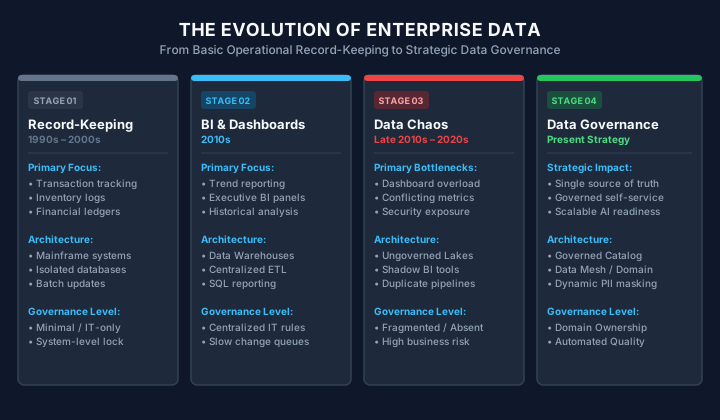
Stage 1: Basic Record-Keeping (1990s–2000s)
Data was primarily used as an operational byproduct for transactional tracking—storing customer ledgers, managing inventory, and recording financial entries across isolated legacy mainframes.
Stage 2: Business Intelligence & Dashboards (2010s)
The rise of enterprise BI tools and cloud warehouses enabled teams to aggregate data, create visual reports, and analyze historic trends. Decision-making shifted from intuition to metric-driven insights.
Stage 3: Uncontrolled Expansion & Data Chaos (Late 2010s–2020s)
As departments adopted self-service tools independently, data creation exploded without central oversight. Different business units created overlapping dashboards with conflicting metric definitions, leading to "dashboard proliferation" and severe data quality degradation [TDWI, Analytics Maturity Model].
Stage 4: Strategic Data Governance (Present)
Organizations reach a tipping point where ungoverned data becomes an operational liability. Forward-looking enterprises implement structured governance to unify metadata, enforce data quality, ensure regulatory compliance, and enable scalable AI and self-service analytics [ED Council, DCAM v2].
The Hidden Costs of an Ungoverned Data Ecosystem
- Information Overload Without Structure: Unmanaged data ingestion from IoT, SaaS tools, and web interactions accumulates in ungoverned data lakes, resulting in duplicate records and high storage overhead.
- Dashboard Proliferation: Marketing, Sales, and Finance build isolated dashboards using different formulas for identical metrics (e.g., Customer Acquisition Cost or Net Retention Rate), generating conflicting "versions of the truth" in executive meetings.
- Data Inaccessibility & Slow Decision-Making: Business users waste hours searching for relevant, certified datasets, forcing teams to make critical decisions based on incomplete or outdated information.
- Heightened Security and Privacy Exposure: Sensitive Customer Identifiable Information (PII) is accessed without dynamic masking or role-based controls, creating major exposure under regulations such as GDPR, CCPA, and LGPD.
- Stalled AI and Machine Learning Initiatives: Advanced analytics and Generative AI models fail in production because they are trained on unvalidated, inconsistent source data.
The Strategic Impact of Data Governance
Implementing a structured data governance framework replaces operational friction with business agility:
| Governance Objective | Without Data Governance | With Strategic Data Governance |
|---|---|---|
| Data Quality & Metrics | Multiple conflicting definitions for key financial and operational KPIs. | Standardized Business Glossary establishing a Single Source of Truth. |
| Analytics Accessibility | Business teams depend on IT ticketing queues for minor report changes. | Federated self-service access to certified, pre-validated data products. |
| Security & Privacy | Manual, inconsistent data access approvals across spreadsheet copies. | Automated Role-Based Access Control (RBAC) with column-level PII masking. |
| Operational Efficiency | High labor costs spent manually cleaning and reconciling spreadsheets. | Automated pipeline validation checks and streamlined data integration. |
Building Your Governance Foundation: 5 Core Priorities
To transition your organization from data chaos to a governed, scalable asset, focus on five foundational steps:
- Establish a Unified Business Glossary: Formally define core enterprise business terms (e.g., Active Customer, Churn, ARR) so all business units calculate metrics consistently.
- Assign Explicit Domain Ownership: Appoint executive Data Owners and operational Data Stewards accountable for the accuracy and security of specific data domains.
- Deploy a Governed Data Catalog: Implement a searchable metadata catalog where business users can easily discover certified datasets, lineage maps, and quality scores.
- Automate Pipeline Data Quality Checks: Embed automated validation guardrails at data ingestion points to detect schema drift and duplicate records before data enters production analytics.
- Roll Out Enterprise Data Literacy: Train business teams on data privacy standards, self-service tools, and responsible data handling practices.
Conclusion: The Time for Data Governance is Now
Organizations can no longer treat data growth as an unmanaged byproduct of IT infrastructure. As enterprise operations become increasingly data-dependent, structuring and governing information assets is a mandatory prerequisite for sustainable growth.
By establishing clear roles, automated guardrails, and transparent metadata today, your organization secures the foundation required for scalable analytics, regulatory compliance, and confident executive decision-making.
Ready to Evaluate Your Data Governance Foundation?
Is data chaos or conflicting report metrics slowing down your organization's decision-making? Take our quick diagnostic assessment to benchmark your maturity across People, Process, Technology, and Data, and receive a tailored improvement roadmap.