
Why do organizations actually invest time, capital, and engineering effort into Data Governance?
If you ask ten different Chief Data Officers or executive leaders, you will likely receive ten distinct answers. Some companies embark on a data governance journey because they recently suffered a public security breach or a $5,000,000 regulatory compliance penalty. Others initiate governance because they are preparing for an imminent merger, or because C-suite executives realize that unreliable internal dashboards are sabotaging daily commercial decisions.
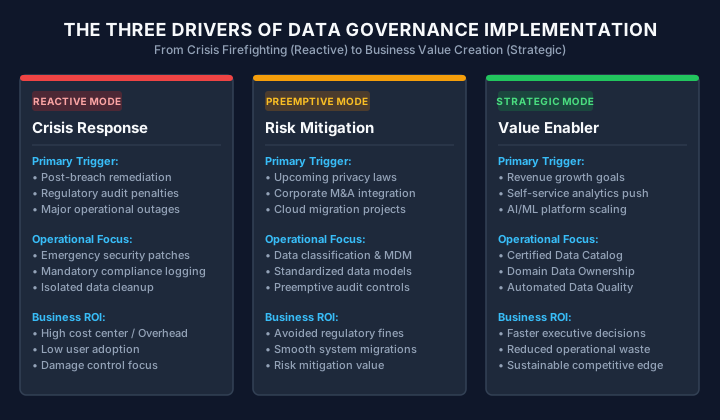
In practice, organizational motivation for data governance falls along a spectrum: Reactive, Preemptive, or Strategic [DAMA International, DMBOK2].
Understanding where your company sits on this spectrum is critical for defining program scope, securing executive sponsorship, and ensuring long-term business adoption [Gartner, Data Governance Framework].
The Governance Spectrum: Reactive, Preemptive, and Strategic
REACTIVE GOVERNANCEFirefighting Mode
Driver: Post-crisis remediation (data breaches, audit fines, system crashes)
PREEMPTIVE GOVERNANCERisk Mitigation
Driver: Anticipating future threats (regulatory shifts, M&A integration)
STRATEGIC GOVERNANCEValue Driver
Driver: Monetization, operational efficiency, self-service, competitive edge
1. Reactive Governance: Fixing Problems After the Damage Is Done
Reactive data governance is an immediate, defensive response to an operational crisis that has already caused financial loss, legal liability, or reputational damage.
Organizations operating in reactive mode typically view governance as a necessary cost center or an emergency insurance policy. While reactive programs succeed in containing immediate risks, they are often implemented under high stress and with elevated remediation costs [ED Council, DCAM v2].
Real-World Example A: The Retail Data Security Breach
A global retail enterprise experienced a major cybersecurity breach exposing millions of unmasked customer payment records. Beyond severe regulatory fines and legal class actions, customer churn spiked.
In response, executive leadership launched an emergency data governance program that:
- Enforced strict Role-Based Access Control (RBAC) across all customer databases.
- Implemented dynamic data masking and column-level encryption for sensitive PII.
- Established formal audit routines to comply with global data privacy regulations (e.g., GDPR, CCPA).
Real-World Example B: The $5M Financial Audit Fine
A mid-sized financial institution was fined $5,000,000 following an independent regulatory audit that uncovered missing transaction logs, mismatched currency attributes, and orphan records.
To restore compliance and maintain its operating license, the bank reactively:
- Implemented automated Data Quality checks at pipeline ingestion points.
- Appointed formal Data Owners and Data Stewards for core financial ledgers.
- Established an internal reporting workflow to ensure total transaction auditability.
2. Proactive Governance: Anticipating Risks and Driving Value
Proactive data governance moves beyond crisis management. It treats data as a high-value corporate asset and embeds controls before operational failures occur. Proactive governance divides into two distinct maturity approaches:
Approach 1: Preemptive Governance (Anticipating Future Threats)
Preemptive governance focuses on identifying emerging risks, regulatory shifts, or major structural transformations, addressing bottlenecks before they impact the bottom line.
- Preparing for New Data Privacy Laws: A regional healthcare provider anticipated stricter regional patient privacy regulations. Rather than waiting for enforcement dates, they proactively classified all patient data domains, tightened access rules, and established automated audit logs—achieving seamless compliance without operational disruption.
- Streamlining Post-Merger Data Integration: A national bank acquired a regional competitor, inheriting legacy systems with conflicting schema definitions. Instead of manually reconciling tables post-acquisition, leadership deployed a preemptive Master Data Management (MDM) strategy and consolidated systems into a governed cloud lakehouse, preventing multi-million dollar integration delays.
Approach 2: Strategic Governance (Unlocking Business Operations & ROI)
Strategic governance represents the highest tier of analytical maturity [TDWI, Analytics Maturity Model]. Here, governance is explicitly leveraged to optimize operational efficiency, accelerate decision-making, and create competitive market advantages.
| Strategic Domain | Traditional Un-Governed State | Strategic Governed State |
|---|---|---|
| Executive Decision-Making | Analysts spend weeks manually reconciling conflicting sales figures across shadow spreadsheets. | Single Source of Truth via a certified Data Catalog, enabling real-time executive decision-making. |
| Supply Chain & Inventory | Over-ordering ingredients or stockouts due to fragmented, unvalidated inventory records. | Real-time demand forecasting powered by automated inventory tracking, cutting waste by 18%. |
| Self-Service Analytics | Business teams submit tickets to central IT, waiting weeks for simple report modifications. | Federated self-service analytics with automated access guardrails and certified metric glossaries. |
Comparing the Three Governance Approaches
Understanding the trade-offs across each approach helps data leaders articulate the business case for advancing their governance maturity:
| Dimension | Reactive Governance | Preemptive Governance | Strategic Governance |
|---|---|---|---|
| Primary Catalyst | Data breach, audit penalty, major outage. | Imminent regulation, M&A activity, cloud migration. | Revenue growth, cost reduction, self-service analytics. |
| Organizational Perception | Bureaucratic expense / emergency firefighting. | Risk management & compliance requirement. | Value-generating business enabler & competitive edge. |
| Implementation Cost | High (emergency consulting & expedited software fees). | Moderate (planned project budget allocation). | Highly Efficient (reinvested savings & scalable architecture). |
| Cultural Impact | Low adoption; viewed as punitive red tape. | Moderate adoption; understood as necessary safety rules. | High adoption; embedded into daily business workflows. |
Practical Roadmap: Shifting from Reactive to Strategic Governance
If your organization is currently trapped in a reactive firefighting cycle, follow these five steps to transition toward a proactive, strategic governance model:
- Quantify the Cost of Crisis: Calculate the true financial impact of past data errors, labor spent on manual data cleaning, and audit compliance expenses.
- Focus on High-Impact Value Streams: Align your governance initiatives directly with primary revenue or operational drivers (e.g., Customer Master Data or Supply Chain Tracking).
- Formalize Domain Ownership: Move beyond IT-driven governance by appointing executive Data Owners and operational Data Stewards within business units.
- Deploy Automated Ingestion Guardrails: Replace manual approval bottlenecks with automated data quality profiling and role-based access provisioning.
- Publish Certified Data Assets: Use a central data catalog to badge trusted, production-ready datasets, enabling self-service analytics without compromising security.
Ready to Evaluate Your Data Governance Foundation?
Is your organization reacting to data crises or proactively leveraging data as a strategic asset? Take our quick diagnostic assessment to benchmark your governance maturity across People, Process, Technology, and Data, and receive a customized improvement roadmap.