
If you rewind a few decades, corporate data was relatively straightforward. Organizations operated fewer systems, managed smaller datasets, and maintained clear lines of technical responsibility. Everyone knew where customer files lived and who was responsible for maintaining them. Information moved through departments slowly and predictably—and when errors occurred, the operational blast radius was manageable.
Fast forward to today: enterprise data volumes have exploded exponentially, cloud architectures have multiplied, and real-time data sharing happens instantaneously across global networks.
Yet, organizational structures for assigning data responsibility have failed to keep pace. The result? Modern enterprises find themselves buried under petabytes of information that is "touched by many, owned by none."
As renowned governance expert Nicola Askham famously noted, "As data piles up, so do the problems—ownership confusion, unclear responsibilities, quality issues, and compliance risks."
With organizations managing five to six times more data sources than just a few years ago, establishing explicit Data Ownership is no longer an optional administrative exercise: it is the bedrock of enterprise trust, regulatory compliance, and commercial value [DAMA International, DMBOK2].
Where the Ownership Problem Begins
Why do so many sophisticated enterprises struggle to answer the simple question: "Who owns this dataset?"
The breakdown typically stems from four systemic root causes within the organization:
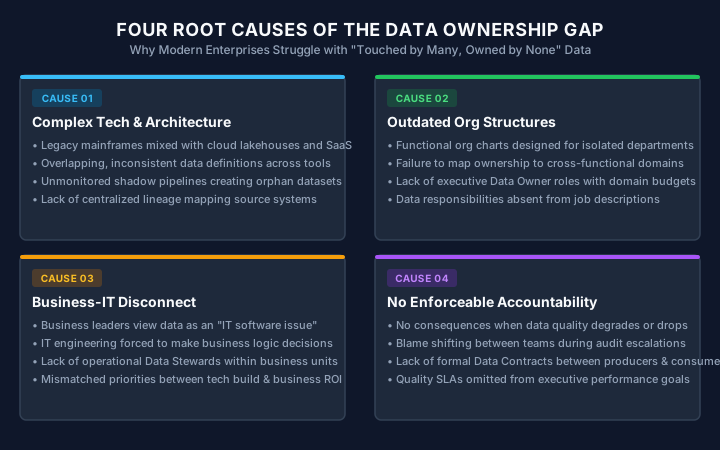
- Complex, Fragmented Data Architectures: Legacy mainframes mixed with modern cloud data lakehouses and SaaS applications create messy, overlapping data definitions.
- Outdated Organizational Structures: Hierarchical org charts designed for siloed functional departments have not evolved to match cross-functional, domain-driven data flows.
- The Business-IT Disconnect: Business leaders often view data as a "software problem" belonging solely to IT engineering, while technical teams lack the commercial context to define business rules.
- Absence of Enforceable Accountability: Without explicit governance policies, teams default to shifting blame whenever data quality drops or audit failures occur [Gartner, Data Governance Framework].
When no individual steps up to take responsibility for data health, enterprise data quality degrades silently across the entire value chain.
Why Modern Software Tools Alone Won't Fix the Ownership Gap
To solve this challenge, modern data catalogs and data mesh platforms now weave ownership features directly into their technical architecture. Advanced platforms offer:
- Centralized Ownership Registries: Global directories mapping every database table, topic, and API to a specific business domain, complete with designated contact owners and escalation paths.
- Automated Incident Routing: Observability workflows that automatically trigger alerts to the appropriate Data Steward the moment schema drift or pipeline errors occur.
- Accountability Dashboards: Executive interfaces that track how effectively domain teams uphold data quality SLAs and resolve escalations.
- Data Contracts & SLAs: Formalized operational agreements between data producers and consumers locking in schema expectations, freshness guarantees, and response times [ED Council, DCAM v2].
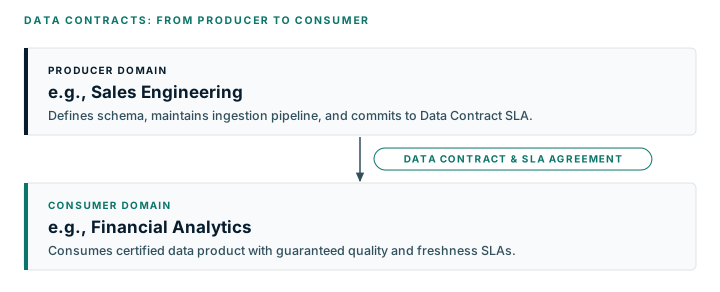
While these technical capabilities are invaluable, software tools are merely window dressing without human accountability. A data catalog can store an owner's name, but it cannot force a business executive to care about data quality or allocate budget for remediation.
Making Data Ownership Work in Practice: Roles & Responsibilities
Modern Data Governance bridges the gap between software capabilities and organizational behavior. It creates clear, operational lines of responsibility connecting business leaders with technical execution:
| Organizational Role | Primary Governance Focus | Core Operational Responsibilities |
|---|---|---|
| Data Owner (Business Executive) | Strategic Domain Accountability | Defines domain business rules, sets quality thresholds (e.g., 99.5% accuracy), approves access rights, and funds remediation. |
| Data Steward (Domain Subject Matter Expert) | Tactical Operational Oversight | Maintains business glossary definitions, investigates automated quality alerts, and manages day-to-day data remediation. |
| Data Engineer (Technical Infrastructure) | Technical Execution & Delivery | Builds and maintains automated ETL/ELT pipelines, enforces security masking, and implements automated validation tests. |
| Business Consumer (Data Analyst / End-User) | Active Feedback Loop | Uses certified datasets for decision-making and escalates anomalies to the Data Steward rather than creating shadow spreadsheets. |
Practical Example: Customer Master Data
A Vice President of Sales serves as the Data Owner for customer domain data because sales leadership understands the commercial value of accurate customer profiles and the revenue risks of flawed contact details.
Operational Data Stewards within sales operations assist the owner by monitoring daily data quality dashboards, resolving duplicate customer records, and refining business rules.
Meanwhile, Data Engineers maintain the underlying cloud database infrastructure, ensuring security masking and pipeline uptime—without being forced to make business decisions about what "good customer data" looks like.
Bridging the Gap: Your Implementation Roadmap
Overcoming the data ownership gap requires a cultural shift backed by structured governance practices [TDWI, Analytics Maturity Model]:
- Transition to Domain-Driven Governance: Organize data ownership around natural business domains (e.g., Customer, Product, Supply Chain, Finance) rather than IT database tables.
- Formally Appoint Named Owners: Assign named, executive Data Owners with explicit accountability written into their annual performance goals.
- Implement Data Contracts for Critical Assets: Deploy formal agreements between data-producing and data-consuming teams for your top 20% most critical datasets.
- Publish a Centralized Ownership Registry: Ensure every business user can easily search your data catalog to see who owns a dataset, what it means, and how to report issues.
- Reward Proactive Stewardship: Recognize and reward domain teams that actively clean their data and maintain high quality scores.
Conclusion
Organizations cannot automate their way out of the data ownership gap. Resolving confusion around data responsibility requires leadership, cultural change, and a governance framework designed for modern data scale.
The business payoff is immediate and transformative: fewer finger-pointing meetings when reports mismatch, higher executive trust in decision-making metrics, and an organization that confidently leverages its data as a secure, high-value asset.
Ready to Evaluate Your Data Governance Foundation?
Is confusion over data ownership delaying decisions or creating quality issues in your organization? Take our quick diagnostic assessment to benchmark your current capabilities across People, Process, Technology, and Data, and receive a customized improvement roadmap.