
The Overlooked Chapter: Why Change Management Is the Key to Data Governance Success
When enterprise leaders think about Data Governance, their minds immediately jump to policy frameworks, data quality rules, enterprise catalogs, and steering committees. Few consider organizational Change Management.
And yet, in the DAMA Data Management Body of Knowledge [DAMA International, DMBOK2], the final chapter is dedicated specifically to Organizational Change Management—and for good reason. Without addressing human behavior, all the frameworks, data architectures, and software tools in the world will fail to transform your organization into a truly data-driven enterprise.
Data governance is not a technical implementation; it is a fundamental cultural transformation.
Why Change Management Matters in Data Governance
Data governance alters how employees capture, validate, access, and interpret information daily. It redefines accountability, redistributes authority over data assets, and introduces new operational routines.
If an organization establishes strict data governance policies but employees continue to export raw files into ungoverned local spreadsheets, governance has not been achieved—you have simply published a rulebook that nobody reads.
Change management bridges the gap between policy creation and operational adoption. It ensures that stakeholders understand why the transformation is necessary, how it directly benefits their daily workflows, and what specific behaviors must change [Gartner, Data Governance Framework].
Governance Equals Cultural Transformation
A mature data governance program does not merely assign data ownership on an organizational chart—it builds a lasting culture of data stewardship and cross-functional trust.
However, cultural evolution does not occur by accident. It requires deliberate communication, stakeholder engagement, and continuous reinforcement over time [ED Council, DCAM v2].
Integrating structured change management into your governance strategy provides the framework required to:
- Communicate the Strategic Vision: Articulate why data matters to the business and how governance directly supports revenue, compliance, and operational efficiency.
- Generate Executive and Operational Buy-In: Demonstrate the tangible value proposition for each department—fewer reporting discrepancies, faster decision-making, and reduced manual reconciliation work.
- Drive Sustainable Adoption: Provide targeted training, operational support, and formal recognition for teams that embrace governed workflows.
- Reinforce New Behaviors: Embed data stewardship habits into daily business operations until governed practices become "just how we do things here."
Without this human-centric structure, data governance remains a theoretical exercise—a set of well-intentioned slides rather than an active business practice.
The Psychology of Data-Driven Change
Change management recognizes a fundamental truth that technical leaders often overlook: resistance to change is normal and expected.
Employees do not resist data governance out of stubbornness. They resist because:
- They do not understand what is changing or why it matters to their role.
- They fear losing autonomy over their local processes or reporting metrics.
- They perceive governance as additional bureaucratic friction without clear personal benefits.
Acknowledging these psychological barriers is not a sign of organizational weakness—it is a core strategy. Successful data leaders build empathy into their rollout plans. They actively listen to business frustrations, adapt policies to fit operational realities, and design governance with the business rather than imposing it upon the business.
Practical Steps to Integrate Change Management into Governance
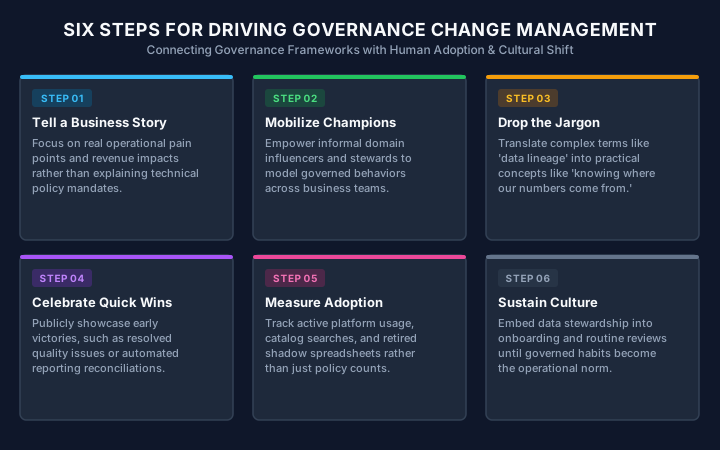
To ensure your data governance program achieves high adoption and long-term viability, follow these five practical steps:
1. Lead with a Business Story, Not a Technical Policy
Before defining technical standards or mandatory metadata fields, explain the core problem. Use real-world examples of data failures within your organization—such as a miscalculated quarterly sales forecast or a delayed customer campaign—to illustrate how governance prevents operational friction and protects revenue.
2. Mobilize Governance Champions
Empower informal influencers, operational Data Stewards, and domain team leads who believe in the value of trusted data. Equipping these champions to model governed behaviors within their respective departments creates peer-to-peer momentum that central IT teams cannot replicate.
3. Translate Jargon into Business Plain Language
Technical governance terminology alienates business stakeholders. Replace technical jargon with clear, business-oriented phrasing:
- Instead of "enforcing end-to-end data lineage," say "knowing exactly where our financial numbers come from."
- Instead of "establishing a canonical data model," say "agreeing on a single definition for 'active customer.'"
4. Celebrate Quick Operational Wins
Highlight and publish early governance victories. Whether a domain team successfully resolves a persistent data quality issue or automates a previously manual reconciliation process, make the win visible across the enterprise. Demonstrating immediate value builds credibility and momentum.
5. Measure Behavioral Adoption, Not Just Compliance
Tracking the number of published policies or documented data catalog terms measures output, not business impact. Focus your governance metrics on active adoption:
- How many business users consult certified datasets in the data catalog weekly?
- What is the average time required to resolve a data quality escalation?
- How many ungoverned shadow spreadsheets have been retired in favor of enterprise BI dashboards?
Measuring Governance Maturity Through Adoption
Evaluating the maturity of your data governance program requires measuring both technical capability and organizational adoption [TDWI, Analytics Maturity Model]:
| Governance Dimension | Low Change Management Maturity | High Change Management Maturity |
|---|---|---|
| Policy Rollout | Unilateral PDF distribution with mandatory compliance mandates. | Interactive workshops translating policies into operational workflows. |
| Data Stewardship | Assigned as an uncompensated IT task without business context. | Formally recognized role with clear career pathways and domain authority. |
| User Engagement | High ticket volume requesting bypasses to security controls. | Active community of practice collaborating on dataset improvements. |
| Executive Support | Sponsorship limited to initial software procurement. | Continuous leadership reinforcement connecting governance to strategic KPIs. |
Change Is the Ultimate Data Challenge
If data governance is the engine of a modern, data-driven enterprise, change management is the fuel that drives it forward.
Technology stacks, data catalogs, and governance frameworks can be purchased off the shelf. But changing how human beings think, collaborate, and make decisions requires genuine leadership.
That is why the final chapter of the DAMA DMBOK should be the very first framework every data leader reads and applies.
Ready to Evaluate Your Data Governance Foundation?
Is human resistance or low adoption stalling your data governance initiatives? Take our quick diagnostic assessment to evaluate your organization's readiness and receive an actionable improvement roadmap.