
When Good Data Goes Bad: Why End-to-End Data Quality is the Backbone of Governance
Imagine this scenario: it is the end of the quarter. Your executive dashboard presents dazzling revenue and customer retention metrics. The C-suite breathes a sigh of relief and approves the next phase of expansion plans based on these figures. Then, three weeks later, a silent error surfaces during a routine finance audit. Historical churn was miscalculated due to an unannounced API schema shift, forecasts are off by millions, and the board discovers the discrepancy before your team can issue a correction.
Does this sound familiar?
In modern enterprise environments, this crisis recurs frequently not because organizations lack sophisticated analytics tools, but because Data Quality is treated as a reactive, one-off cleanup task rather than a continuous engineering discipline embedded across the entire data value chain [DAMA International, DMBOK2].
A robust Data Governance framework cannot survive as mere policy documentation. To protect decision-making, manage enterprise risk, and maximize ROI, organizations must embed end-to-end data quality controls into every layer of their architecture—from source ingestion to the final consumer dashboard.
The Propagation Effect: How Bad Data Travels and Multiplies
The greatest operational risk in contemporary data platforms (such as modern data stacks, data lakes, and enterprise warehouses) is rarely a total pipeline crash. A hard failure raises alerts and halts execution.
The far more dangerous threat is the silent spread of corrupted data.
When corrupted or incomplete records enter your ecosystem at ingestion, they pass unnoticed through business logic transformations. Along the way, flawed data does not remain static; it compounds. An unvalidated null value or a mismatched currency code in an operational database morphs into incorrect aggregate calculations during ETL/ELT pipelines, settles quietly into production tables, and feeds executive dashboards with absolute confidence.
Silent Degradation Across the Value Chain
Each stage adds visual polish—sleek UI components, clean chart legends, and impressive trend lines—yet the core payload remains fundamentally flawed. By the time a decision-maker views the report, the error is insulated by layers of technical processing.
According to research on analytical maturity [TDWI, Analytics Maturity Model], organizations operating without continuous quality guardrails lose up to 20% to 30% of operating revenue addressing the downstream consequences of poor data quality, ranging from regulatory compliance penalties to misallocated capital.
The Four Guardrails of End-to-End Data Quality Governance
To prevent silent failures, mature data governance programs integrate validation checks into every critical phase of the data lifecycle. Following established industry frameworks [ED Council, DCAM v2], data quality must be managed as an active pipeline discipline across four foundational guardrails:
| Lifecycle Stage | Operational Focus | Primary Quality Mechanisms & Guardrails |
|---|---|---|
| 1. Ingestion | Source validation & schema enforcement | Pre-ingestion schema validation, completeness checks, source format verification |
| 2. Transformation | Business logic & relational integrity | Automated unit/integration tests, cross-table reconciliations, anomaly detection |
| 3. Storage | Persistence health & drift monitoring | Volume monitoring, freshness tracking, duplicate detection, orphan record isolation |
| 4. Consumption | Final-mile delivery & metric consistency | Metric definitions sanity checks, dashboard guardrails, lineage tracking |
1. Ingestion Guardrails: Stopping Junk at the Gate
The most cost-effective place to fix data quality issues is at the exact moment of creation or ingestion. Allowing invalid data into your primary storage infrastructure multiplies remediation costs exponentially down the line.
- Schema Enforcement: Prevent unannounced upstream changes (such as renamed columns or altered data types) from corrupting downstream production tables.
- Format & Range Validations: Automatically reject or quarantine incoming records that fail structural rules (e.g., negative transaction amounts, malformed email addresses, or invalid regional codes).
- Completeness Checks: Ensure critical primary keys and mandatory business attributes are populated before permitting batch processing or streaming write executions.
2. Transformation Guardrails: Protecting Business Logic
Even when raw ingestion data is pristine, data quality often degrades during data modeling, joining, and aggregation.
- Automated Logic Testing: Implement automated pipeline testing (using modern data transformation tools) to verify that joins do not cause unexpected row fan-out or record drops.
- Business Rule Validation: Enforce semantic rules explicitly. For instance, if an e-commerce platform processes a return, the system must validate that the corresponding purchase record exists and that the return value does not exceed the original order value ($10,000 max single-order thresholds, for example).
- Reconciliation Checks: Run automated cross-table audits after transformation cycles to confirm that source totals match target summary tables dollar for dollar.
3. Storage Guardrails: Continuous Warehouse & Lake Monitoring
Data stored within modern data warehouses (e.g., Snowflake, BigQuery, Databricks) can degrade over time due to system updates, late-arriving data, or legacy integration scripts.
- Volume and Freshness Anomalies: Monitor table pipelines for sudden drops in record counts or delayed update cycles that signal pipeline stalls.
- Deduplication Routines: Run automated background jobs to identify and resolve duplicate entity records using unique business keys.
- Orphan & Drift Detection: Periodically audit historical storage layers to identify orphaned child records that lack valid parent entities or schema drift that breaks historical comparisons.
4. Consumption Guardrails: Protecting the Final Mile
The last mile of data delivery is your final safety net before insights inform commercial strategies, investor communications, or customer interactions.
- Dashboard Metric Sanity Checks: Implement automated threshold alerts on key performance indicators (KPIs). If daily active users or revenue metrics swing outside three standard deviations of historical baselines, flag the dashboard for review before executive presentation.
- Business Glossary Alignment: Verify that underlying reporting queries pull from standardized data models rather than custom, ungoverned SQL calculations embedded directly within BI tools.
- Lineage Visibility: Provide business consumers with immediate visibility into data freshness and pipeline status directly within the BI interface, establishing clear trust signals.
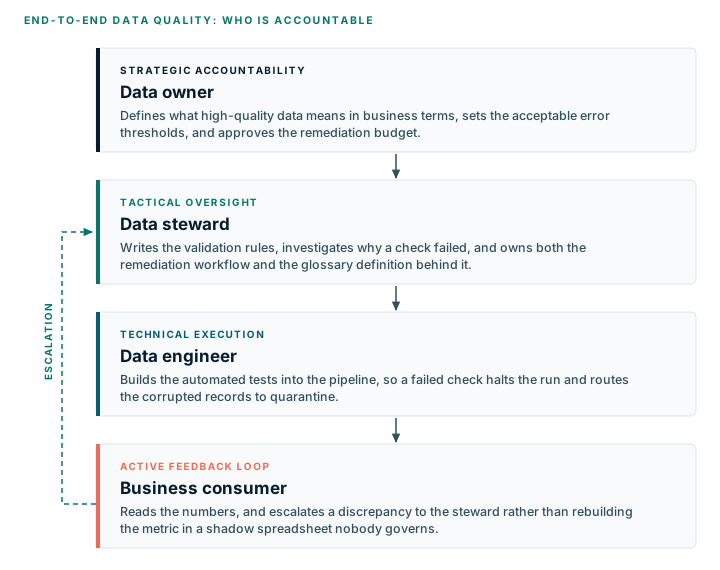
People and Accountability: Tying Roles to Quality
Processes and automated tools are ineffective without explicit organizational ownership. High-performing governance models [Gartner, Data Governance Framework] align data quality responsibilities across well-defined organizational roles, ensuring that no error hides behind a lack of clear ownership.
The Data Owner (Strategic Accountability)
Senior business leaders (e.g., VP of Finance, Head of Supply Chain) who hold ultimate accountability for a specific data domain. They define what "high-quality data" means in business terms, set acceptable error thresholds (e.g., 99.9% billing record accuracy), and approve remediation budgets.
The Data Steward (Tactical Oversight)
Operational domain experts who work closely with data on a daily basis. They define technical validation rules, investigate root causes when automated quality checks fail, manage data remediation workflows, and maintain business glossary definitions.
The Data Engineer (Technical Execution)
Technical specialists who build automated quality tests directly into CI/CD pipelines and data transformation layers. They ensure that failed checks halt pipelines, trigger automated alerts, and route corrupted records to quarantine tables for review.
The Business Consumer (Active Feedback Loop)
End-users across departments who possess basic data literacy. When metric discrepancies arise, consumers follow structured escalation paths to notify Data Stewards rather than creating localized "shadow spreadsheet" workarounds.
Quantifying the Business Impact: From Cost Center to ROI
When organizations implement end-to-end data quality discipline, data governance evolves from an administrative expense into a direct value driver.
Consider a multi-national enterprise evaluating a major acquisition:
- Without End-to-End Governance: The M&A team spends $150,000 on external consultants over six weeks simply reconciling customer master data and cleaning conflicting revenue figures across legacy systems.
- With End-to-End Governance: Clean, audited data domains allow the internal strategy team to evaluate target assets immediately using verified, trusted datasets—saving time, reducing advisory costs, and mitigating strategic risk.
Traditional Reactive Approach:
[ Bad Data ] ---> [ Manual Discovery ] ---> [ Expensive Firefighting ] ---> [ Loss of Trust ]
Proactive Governance Approach:
[ Ingestion Guardrails ] ---> [ Automated Quality Tests ] ---> [ Clean Data ] ---> [ High-Velocity Decisions ]
Building Your End-to-End Quality Roadmap
Moving from reactive cleanup to proactive quality governance does not require an immediate overhaul of your entire tech stack. Follow this step-by-step implementation roadmap:
- Audit Your Critical Data Paths: Trace your top three operational KPIs back to their raw source systems to map every transformation, join, and storage location.
- Identify High-Risk Gaps: Pinpoint where unvalidated data currently enters your system without checks (typically at API ingestion points or manual file uploads).
- Automate Core Ingestion Checks: Deploy immediate, lightweight validation rules at ingestion points for high-priority tables.
- Formalize Domain Ownership: Assign named Data Owners and Stewards to core business domains (Customer, Product, Finance) with explicit quality SLAs.
- Implement Continuous Observability: Integrate automated pipeline monitoring tools to alert teams to schema drift, volume shifts, and stale data in real time.
Ready to Evaluate Your Data Governance Foundation?
Is poor data quality quietly impacting your organization's decision-making and operational agility? Take our diagnostic assessment to evaluate your end-to-end data controls and receive an actionable improvement roadmap.