
Charting Your Course: The Essential Guide to Data Governance Maturity Assessments
Embarking on a Data Governance journey is akin to setting out on an ocean voyage: to reach your destination, you must first know your precise starting coordinates. In enterprise data management, determining where you stand and charting a clear course for continuous improvement requires a structured diagnostic approach.
This is where a Data Governance Maturity Assessment becomes an indispensable strategic asset [DAMA International, DMBOK2].
A maturity assessment evaluates an organization’s current capabilities in managing, securing, and leveraging data. It identifies operational strengths, uncovers hidden risks, and provides an actionable roadmap to elevate data practices across the enterprise. Think of it as a comprehensive health diagnostic that aligns your data architecture with business objectives and regulatory expectations.
Why Is a Data Governance Maturity Assessment Essential?
Organizations often attempt to implement governance policies without first benchmarking their operational baseline. This frequently leads to misaligned investments and low employee adoption. Conducting a formal assessment yields significant strategic benefits:
- Benchmarking Progress: Establishes an objective baseline to measure operational advancements and return on investment (ROI) over time.
- Identifying Structural Gaps: Pinpoints critical vulnerabilities, such as unmanaged data silos, unclear domain ownership, or inconsistent quality standards.
- Strategic Roadmap Alignment: Informs executive decision-making and prioritizes governance initiatives based on verified business needs rather than guesswork.
- Optimized Resource Allocation: Directs capital investments (e.g., $100,000+ software procurement budgets) toward high-impact capability gaps [ED Council, DCAM v2].
How to Conduct an Effective Governance Maturity Assessment
Executing a thorough maturity assessment requires a structured, four-phase methodology that balances stakeholder perspectives with technical evidence:
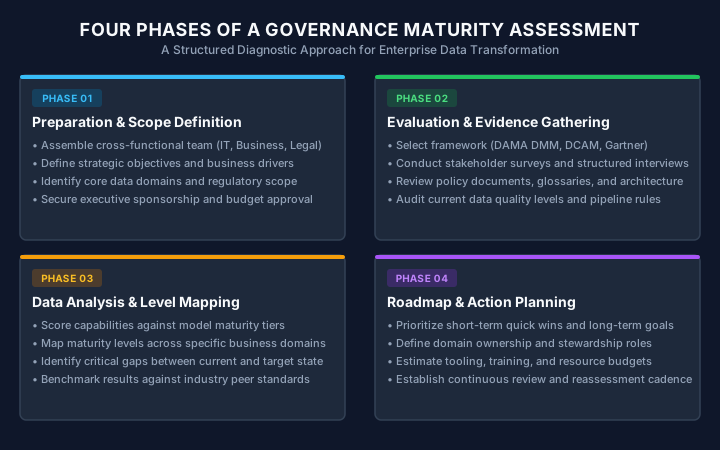
Phase 1: Preparation & Scope Definition
- Assemble a Cross-Functional Team: Include representatives from executive leadership, line-of-business managers, IT engineering, legal compliance, and operational Data Stewards.
- Define Strategic Objectives: Establish clear goals for the assessment, such as accelerating self-service analytics, ensuring GDPR/CCPA regulatory compliance, or resolving multi-departmental reporting discrepancies.
Phase 2: Evaluation & Tool Selection
- Select an Assessment Framework: Choose an established maturity model tailored to your enterprise scale.
- Gather Operational Evidence: Utilize standardized questionnaires, stakeholder interviews, and automated metadata scans to collect qualitative and quantitative evidence across data quality, stewardship, and architecture.
Phase 3: Data Analysis & Level Mapping
- Analyze Findings: Evaluate collected evidence against the benchmark criteria of your selected maturity model.
- Map Operational Capabilities: Determine your current maturity level across specific domains (e.g., Level 1 for Data Quality, Level 3 for Data Security).
Phase 4: Roadmap & Action Planning
- Identify Capability Gaps: Contrast your current state against target maturity goals defined by business strategy.
- Develop an Action Plan: Prioritize short-term "quick wins" alongside multi-year strategic investments, establishing clear timelines and domain accountabilities.
Overview of Prominent Data Governance Maturity Models
Selecting the right framework depends on your industry context and governance goals. Most modern maturity models draw structural inspiration from the Software Engineering Institute's Capability Maturity Model Integration (CMMI) framework, organizing progression across defined evolutionary tiers [TDWI, Analytics Maturity Model].
| Maturity Model | Developer / Origin | Stage Structure | Primary Strategic Focus |
|---|---|---|---|
| DAMA Data Management Maturity Model (DMM) | DAMA International | 5 Levels: Initial, Managed, Defined, Measured, Optimized | Comprehensive, framework-agnostic coverage across all 11 DMBOK data management Knowledge Areas. |
| Gartner Data Governance Maturity Model | Gartner Research | 5 Levels: Initial, Developing, Defined, Managed, Optimized | Business alignment, executive sponsorship, data ownership, and risk mitigation. |
| IBM Data Governance Maturity Model | IBM Corporation | 4 Levels: Initial, Repeatable, Defined, Managed | Formalizing data policies, standardized processes, and enterprise metric consistency. |
| DCAM (Data Management Capability Assessment Model) | Enterprise Data Management Council | 8 Capabilities / 6 Realization Levels | Comprehensive enterprise benchmarking, audit-readiness, and operational capability scoring. |
| Legacy Models (Kalido / DataFlux) | Software Vendors | 4 Evolutionary Stages | Historical frameworks focused on linking governance maturity directly to software value realization. |
Capability Levels: From Reactive Chaos to Strategic Optimization
While terminology varies across frameworks, most maturity models categorize organizational progress along five core evolutionary stages:
[ LEVEL 1: INITIAL / NASCENT ] Reactive, ad-hoc processes; frequent data fires; no formal ownership.
[ LEVEL 2: DEVELOPING / REPEATABLE ] Growing awareness; localized stewardship in isolated departments; basic project-level rules.
[ LEVEL 3: DEFINED / STANDARDIZED ] Enterprise-wide policies established; formal Data Governance Office (DGO); standardized metrics.
[ LEVEL 4: MANAGED / MEASURED ] Quantitative quality tracking; automated controls in CI/CD pipelines; role-based access controls.
[ LEVEL 5: OPTIMIZED / LEADING ] Governance embedded in enterprise culture; continuous automation; data actively drives competitive edge.
Real-World Case Study: A Retailer's Path to Data Maturity
Consider a mid-sized omnichannel retailer struggling with conflicting customer retention figures and mismatched inventory counts between physical stores and e-commerce platforms.
The Initial Challenge
Different regional business units used custom definitions for "active customer." Reconciling monthly revenue figures required manual spreadsheet manipulation, leading to delayed marketing campaigns and stockouts during peak promotional periods.
The Assessment Diagnostic
The retailer conducted an assessment using the IBM Data Governance Maturity Model and identified their organizational maturity as Stage 1 (Initial). The diagnostic revealed a total lack of standardized metric definitions, absent data stewards, and no automated validation rules at ingestion.
The Strategic Transformation
Armed with these findings, the leadership team built a two-year governance roadmap:
- Year 1 (Transition to Defined): Formally assigned Data Owners to Customer and Product domains, established a central Business Glossary, and published standard metric definitions.
- Year 2 (Transition to Managed): Deployed automated data quality monitoring across core data pipelines and implemented role-based access controls in their cloud data warehouse.
The Business Outcome
- Data Consistency: Reconciled customer profiles across all channels, reducing duplicate records by 38%.
- Operational Velocity: Reduced monthly financial closing cycles from 12 days to 3 days.
- Commercial Growth: Increased targeted campaign conversion rates by 22% due to trusted customer segmentation data.
Taking the First Step on Your Governance Journey
A Data Governance Maturity Assessment is not a one-time academic exercise—it is a repeatable compass that keeps your data strategy aligned with evolving market dynamics. By understanding your baseline capabilities and leveraging established global frameworks, you transform data from a source of operational friction into a secure, high-value asset.
Ready to Evaluate Your Data Governance Maturity?
Unsure where your organization sits on the maturity curve? Take our quick diagnostic assessment to benchmark your current capabilities across People, Process, Technology, and Data, and receive a customized improvement roadmap.