
The global enterprise race to adopt Artificial Intelligence is accelerating at an unprecedented pace. Executive boards and C-suite leaders are doubling down on Generative AI (GenAI) pilots, eager to demonstrate immediate commercial value, optimize operational efficiency, and outpace competitors.
However, beneath the hype and promises of transformational productivity, enterprise leaders are discovering a harsh operational reality: you cannot scale AI on untrusted data infrastructure.
Recent industry surveys of Chief Data Officers (CDOs) and analytics executives reveal a striking metric: nearly 70% of Generative AI pilots never reach production deployment [Gartner]. These initiatives stall not from a lack of executive ambition or computational power, but because the foundational data ecosystem is unready. Unmanaged data quality, absent domain ownership, fragmented toolchains, and unrealistic executive expectations continuously derail AI scaling efforts [DAMA International, DMBOK2].
Data governance is not a brake on enterprise innovation—it is the steering wheel that keeps AI initiatives safe, compliant, and commercially valuable.
The AI Expectation Gap: Hype vs. Foundational Reality
A critical challenge facing modern Chief Data Officers is the widening expectation gap between C-suite ambitions and technical realities. Over 90% of data leaders report that executive teams expect GenAI initiatives to deliver measurable return on investment (ROI) within timelines that are fundamentally unrealistic [TDWI, Analytics Maturity Model].
This top-down pressure creates a dangerous temptation: skipping the essential, foundational work of data preparation, schema standardization, and governance enforcement in favor of rushing unvalidated pilots to market.
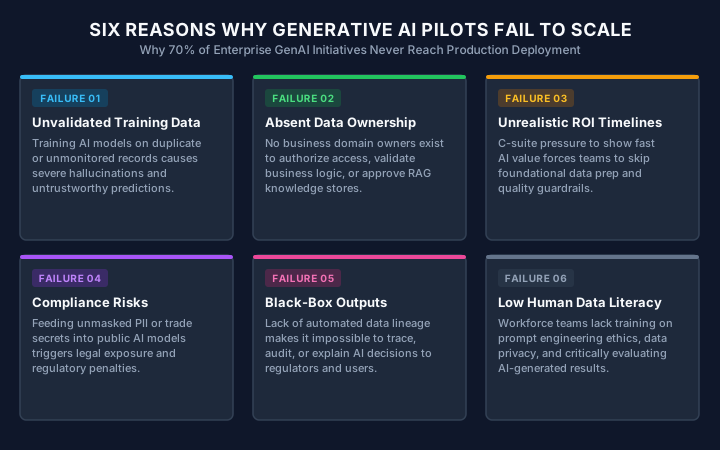
When organizations bypass data governance during model development, the consequences surface rapidly:
- LLM Hallucinations and Bias: Models trained on unvalidated, incomplete, or duplicate records generate confident yet factually incorrect outputs.
- Compliance Exposure: Feeding unmasked Customer Personal Identifiable Information (PII) or proprietary intellectual property into external AI models creates severe regulatory exposure under frameworks such as the EU AI Act and GDPR.
- PoC Stagnation: Proof-of-Concept (PoC) pilots function in controlled sandboxes but fail immediately when exposed to real-world, unmonitored production data streams.
The 5 Governance Pillars of Responsible, Scalable AI
To transform AI from high-risk experiment into a reliable, enterprise-grade capability, data governance must be integrated directly into the machine learning pipeline architecture [ED Council, DCAM v2]. Leading data-driven enterprises prioritize five foundational pillars:
| Governance Pillar | Focus Area in AI Pipelines | Operational Guardrail & Mechanism |
|---|---|---|
| 1. End-to-End Data Quality | Training & fine-tuning data validation | Continuous automated profiling, anomaly detection, and schema enforcement before model ingestion. |
| 2. Explicit Domain Ownership | Data accountability & usage rights | Assigned Data Owners and Stewards who authorize training data access and validate domain accuracy. |
| 3. AI-Aware Governance Policies | Responsible AI usage & ethics | Formal guidelines defining permissible model use cases, bias testing protocols, and IP protections. |
| 4. Metadata & Lineage Tracking | Explainability & auditability | Comprehensive data lineage mapping to trace model outputs back to exact training data versions. |
| 5. Cross-Functional Committees | Strategic risk alignment | Joint steering groups comprising CDOs, CISOs, Legal Counsel, and Business Unit Leaders. |
1. End-to-End Data Quality Management
An AI model is fundamentally a reflection of the data used to train and prompt it. Implementing continuous data profiling, automated validation checks, and deduplication routines at ingestion ensures that training sets and vector databases (RAG architecture) maintain pristine accuracy and completeness.
2. Explicit Domain Ownership and Stewardship
Every dataset feeding an enterprise AI model must have a named Data Owner and Data Steward. Business domain leaders must explicitly validate whether their domain data is accurate, properly classified, and legally permissible for model fine-tuning.
3. AI-Aware Governance Policies
Modern governance frameworks must extend beyond traditional database tables to address AI-specific risk vectors. Organizations must establish clear policies governing model transparency, algorithmic bias prevention, copyright protection, and the handling of sensitive customer records.
4. Comprehensive Metadata and Lineage Tracking
In regulated enterprise environments, AI output explainability is a legal requirement. Implementing end-to-end metadata and automated lineage tracking allows data teams to trace every AI-generated response directly back to the source documents, pipelines, and transformations that informed it.
5. Cross-Functional Steering and Collaboration
Managing AI risk cannot be outsourced solely to IT or data engineering. High-performing governance models establish interdisciplinary committees where Chief Data Officers, Chief Information Security Officers (CISOs), Legal Risk Teams, and Business Unit Heads jointly evaluate AI investment trade-offs.
Training the Human Layer: Data Literacy in the AI Era
While technical guardrails are essential, the human element remains the most vulnerable component of enterprise AI strategies. Industry data indicates that 97% of data leaders face significant operational challenges regarding how employees interact with AI tools—ranging from feeding unvalidated data into public models to misinterpreting probabilistic outputs.
Without organizational Data Literacy, governance policies remain passive compliance documents rather than active behavioral standards.
- Employee
- Inputs Unmasked PII into Public LLM
- Data Leakage & Regulatory Fines
- Employee
- Queries Governed Enterprise RAG
- Audited, Trusted, & Masked Insight
Upskilling workforce teams across all business units to understand data ethics, lineage tracking, dynamic masking, and privacy responsibilities is imperative. Data literacy transforms governance from restrictive red tape into an enterprise culture of responsible innovation.
Quantifying the Value: Governance as an AI Accelerator
When organizations embed governance into their AI strategies, the commercial return on investment shifts dramatically:
- Scenario A (Ungoverned AI Acceleration): A commercial bank rushes an unvalidated customer service AI agent to market. The model hallucinates credit policies, leaks sensitive transaction records, and forces executive leadership to pull the system offline after three weeks, incurring $750,000 in remediation and public relations costs.
- Scenario B (Governed AI Acceleration): The bank deploys a RAG-based AI assistant backed by a governed data catalog, automated column-level PII masking, and explicit domain stewardship. The assistant safely processes 40% of routine customer inquiries in month one, reducing support costs while maintaining 100% compliance.
Building Your AI Data Governance Roadmap
To transition your organization from failing GenAI pilots to scalable, production-grade AI capabilities, execute this structured roadmap:
- Audit Your AI Training Pipelines: Trace the data sources feeding your current AI pilots to identify unvalidated, ungoverned, or unmasked data feeds.
- Classify AI Data Assets: Categorize datasets into sensitivity tiers (Tier 1 Restricted, Tier 2 Operational, Tier 3 Public) to determine automated masking requirements.
- Formalize AI Stewardship: Assign Data Stewards to validate the accuracy and business logic of domain data used in retrieval-augmented generation (RAG) vector stores.
- Implement Automated Observability: Deploy automated observability tools to monitor data drift, schema changes, and model performance metrics in real time.
- Roll Out Enterprise AI Literacy Training: Launch mandatory training modules covering data privacy, prompt security, and responsible AI usage for all business users.
Ready to Evaluate Your Data Governance Foundation?
Is poor data quality or weak governance delaying your organization's AI initiatives? Take our quick diagnostic assessment to benchmark your enterprise data readiness across People, Process, Technology, and Data, and receive a customized improvement roadmap.