
AI governance is not a separate discipline floating above data management. Every model depends on data whose origin, meaning, quality, permissions, and limitations need to be understood. When those things are already governed, an AI policy is a short document that points at controls the organization runs anyway. When they are not, the policy has to invent an entire control environment from scratch, and it usually invents one that nobody operates.
This is the most common pattern I see. A company writes a responsible AI charter, appoints an AI ethics committee, and publishes principles about fairness, transparency, and human oversight. Six months later the committee cannot answer a simple question about a model already in production: which tables feed it, who owns them, when they last changed, and whether the customers in them consented to this use. The principles were never wrong. They just had nothing underneath them.
Why AI governance is mostly data governance
Almost every risk people attribute to a model is inherited from its data. A model is biased because the population it learned from was not representative. It drifts because an upstream source changed shape and nobody told the team. It leaks because a field that should have been classified as sensitive was not. It cannot be explained because the lineage between a training set and its origin was never recorded.
The practical consequence is that an organization with mature data governance can adopt AI far faster than one without it — not because it is more permissive, but because it already knows the answers to the questions a review asks. Ownership, classification, lineage, quality thresholds, and retention rules are the evidence base. AI-specific controls sit on top of them.
Connect AI risks to data controls
Map model risks to the controls that can reduce them, explicitly, so that a review becomes a checklist rather than a debate. Bias concerns connect to representativeness and provenance. Reliability connects to quality thresholds and monitoring. Privacy connects to classification and access.
| AI risk | The data control that reduces it |
|---|---|
| Biased or skewed output | Provenance records and representativeness checks on the training population |
| Unreliable predictions over time | Quality thresholds on source data plus drift monitoring on the inputs |
| Privacy or consent breach | Classification, purpose limitation, and access control at the field level |
| Unexplainable decisions | Lineage from the feature back to the system of record |
| Silent breakage after a change | Ownership of each source, with a change-notification obligation |
The table is deliberately boring. That is the point: none of these controls are AI controls. They are data controls that an AI use case makes urgent.
Clarify accountability
Name the people accountable for the use case, model, source data, and business decision. Shared responsibility without explicit decision rights quickly becomes no responsibility.
Four roles are usually enough to remove the ambiguity:
- Use case owner. Accountable for the business purpose and for whether the model should exist at all.
- Model owner. Accountable for the model's performance, its documented limitations, and its retirement.
- Data owner. Accountable for each source feeding the model: its meaning, its quality, and whether this use is permitted.
- Decision owner. Accountable for the action taken on the model's output, including the decision to override it.
The fourth is the one most often missing. A model that recommends and a person who decides are two different accountabilities, and conflating them is how "human in the loop" becomes a rubber stamp.
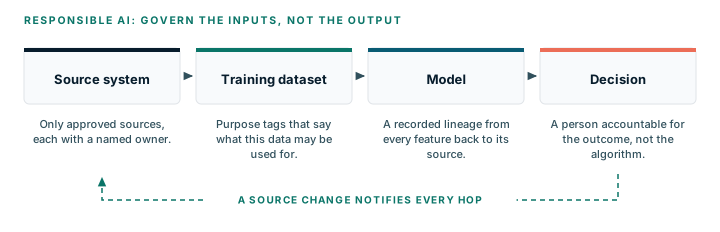
Govern the inputs before you govern the outputs
Output testing gets the attention because it is visible: fairness metrics, red-teaming, evaluation suites. It is necessary and it is not sufficient. A test tells you the model behaved acceptably on the data you tested it with. Governing the inputs is what tells you whether tomorrow's data still resembles that.
Three input controls carry most of the weight. First, an approved-source list: models may only draw from sources with a named owner and a documented purpose. Second, purpose tagging: a dataset collected for billing does not automatically become available for a churn model. Third, change notification: when an upstream schema, definition, or collection method changes, the downstream model owners are told before the change ships, not after the metrics move.
Keep evidence
Document approvals, source changes, tests, limitations, and monitoring results. Good evidence makes responsible practice visible and repeatable.
Evidence is also what turns a regulatory conversation from an argument into a document handover. Regulators, auditors, and enterprise customers increasingly ask the same questions: what data trained this, who authorized it, what did you test, what did you find, and what do you monitor now. An organization that has to reconstruct those answers after the fact will spend weeks on it and will not be confident in the result.
Keep the record close to the work rather than in a separate compliance repository. A model card stored alongside the model, updated as part of the release, is maintained. A spreadsheet updated once a year for an audit is not.
Start where the risk already is
You do not need an AI governance program before you can govern your first model. Start with the use cases already running, or already funded, and work backward to the data they depend on. For each one, answer five questions in writing: what decision does this affect, what sources feed it, who owns each source, what could go wrong for a person on the receiving end, and how would we notice.
Those five answers usually expose the same gap in the same place — an unowned source, an unclassified field, a metric nobody can define — and closing it improves far more than the model. That is the argument worth making internally: responsible AI work is not a tax on the AI program. It is data governance with a deadline and a sponsor.
For the wider mechanics of ownership and decision rights, see Building a Data Governance Operating Model That People Actually Use, and for the distinction between the two disciplines this article keeps leaning on, see Data Governance vs Data Management.