
The question comes up in almost every first conversation I have with a new client, usually phrased as an apology: "I know this is basic, but what is the actual difference between data governance and data management?" It is not basic, and the confusion is not the client's fault. Job postings use the two terms interchangeably. Vendors sell "governance platforms" that are data management tools. Consultants use whichever word the buyer used first.
The distinction matters because the two disciplines fail in different ways, need different people, and are funded from different budgets. Organizations that confuse them tend to make one of two expensive mistakes: they buy a catalog and expect the policy problem to solve itself, or they write a policy set and expect engineering to have somehow implemented it.
Here is the shortest version I can give you. Data governance decides. Data management does. Governance answers who is allowed to decide this, on what evidence, and who is accountable for the outcome. Management answers how the data gets captured, stored, moved, cleaned, secured, and retired. One produces authority and rules; the other produces working systems.
What data governance actually does
Strip away the framework diagrams and governance comes down to three outputs.
The first is decision rights. Somebody has to be able to say what "active customer" means and have that definition stick across finance, marketing, and the board pack. Somebody has to be able to accept a known quality gap in production, in writing, with their name on it. Governance is the mechanism that names those people and the evidence they need before deciding.
The second is policy and standards: the rules that apply whether or not anyone is watching. Retention periods. Classification tiers. What counts as personally identifiable information and what may be done with it. Which attributes on which entities are critical data elements and therefore subject to measurement.
The third is accountability — the part organizations skip. A policy nobody owns is a document. Governance assigns a data owner to each data domain, supports them with data stewards who do the definitional work, and gives both a forum where disputes get resolved rather than escalated indefinitely.
Notice that none of these three outputs is a system. You can produce all of them with a spreadsheet, a recurring meeting, and the authority to make the outcome binding. That is why governance is cheap to start and hard to sustain.
A real governance example
A payments business decides that unmasked card numbers may be viewed only by level-3 administrators, that every such view is logged, and that the head of payments operations is accountable for approving exceptions within two working days. That is governance: a rule, a named decider, an evidence trail, and a service level on the decision.
What data management actually does
Data management is the engineering and operational work that makes data usable across its lifecycle. In DAMA DMBOK terms it is the bulk of the wheel — architecture, modeling, storage, integration, security implementation, reference and master data, warehousing, metadata, and data quality operations.
The outputs here are concrete and largely technical. Pipelines that run on schedule and alert when they do not. A warehouse whose grain is documented. Deduplicated customer records. Backups that have actually been restored at least once. Access controls configured to match the classification policy. Data lineage captured well enough that when a number changes you can find out why.
A real management example
The same payments business builds column-level masking in the warehouse, wires the level-3 role into its identity provider, ships audit logging to a retained store, and adds a nightly job that flags any table where card data appears unmasked outside the approved schema. That is management: the policy above, made real in systems, with the failure modes instrumented.
Where the confusion comes from
Three things blur the line in practice.
Governance is often implemented through management tooling. The business glossary inside your data catalog is a management artifact holding a governance decision. Because the decision lives in a tool, people conclude the tool made the decision.
The job titles overlap badly. A "data governance manager" frequently spends most of the week on quality remediation, which is management work. A "data platform lead" often ends up arbitrating definitions because nobody else will, which is governance work being done without a mandate.
And the DMBOK wheel puts governance at the center, which reads to newcomers as governance is the most important function rather than governance is the function that coordinates the others. Centrality is about relationship, not rank.
Key differences at a glance
| Aspect | Data Governance | Data Management |
|---|---|---|
| Core question | Who decides, on what evidence, and who is accountable? | How do we capture, store, move, protect, and retire it? |
| Primary outputs | Decision rights, policies, standards, ownership, forums | Architecture, pipelines, models, controls, quality operations |
| Typical roles | Data owners, stewards, governance council, governance office | Data engineers, architects, DBAs, platform and security teams |
| Fails as | A policy library nobody applies | A well-run platform serving data nobody agrees on |
| Measured by | Coverage of ownership, decision cycle time, reuse of approved definitions | Uptime, freshness, defect rates, incident recovery time |
| Budget lives in | Business or transformation | IT or platform engineering |
How they work together: a hospital
Consider clinical records in a mid-sized hospital group.
Governance decides that a patient's record may be read by the care team currently treating them, that "currently treating" is defined by an active episode in the admissions system, that the clinical director owns the definition, and that research access requires ethics approval plus de-identification to a documented standard.
Management implements it: the identity integration that resolves a clinician to an active episode, the de-identification pipeline that produces the research extract, the encryption at rest, the retention job that ages records to archive on the legal schedule, and the monitoring that catches a clinician reading records outside their episode list.
Now remove one side and watch what happens.
Without governance, management still builds all of it — but the definition of "care team" comes from whoever wrote the ticket. It differs between the admissions integration and the research extract. Six months later an auditor finds that the research dataset included records the ethics approval did not cover, and there is no one whose job it was to have noticed.
Without management, governance produces an exemplary access policy that the systems cannot enforce. Clinicians share logins because the role model was never implemented. The policy is quoted in the incident report as evidence that the organization knew what it should have been doing.
Both failure modes are common. The second is more embarrassing; the first is more expensive, because it is invisible until something depends on it.
How to tell which one you are missing
A short diagnostic, from the questions I ask in the first week of an engagement.
You have a governance gap if two teams report different values for the same named metric and there is no forum that can settle it; if you cannot name the accountable person for your top five data domains inside a minute; if access requests are decided by whoever is on duty; or if a quality problem has been known for a year and nobody has either fixed it or formally accepted it.
You have a management gap if the definitions are agreed and documented but the reports still disagree; if lineage exists only in the heads of two engineers; if nobody has tested a restore; or if the classification policy is clear and the access controls do not reflect it.
Most organizations have both gaps and treat only the one their loudest function owns. If you want to size the second one before you argue for budget, the cost of bad data calculator turns rework hours and duplicate records into an annual figure, and the maturity assessment will tell you which side of this line your weaknesses sit on.
The artifacts that sit on the boundary
A few things belong to both disciplines, and they are where most arguments happen.
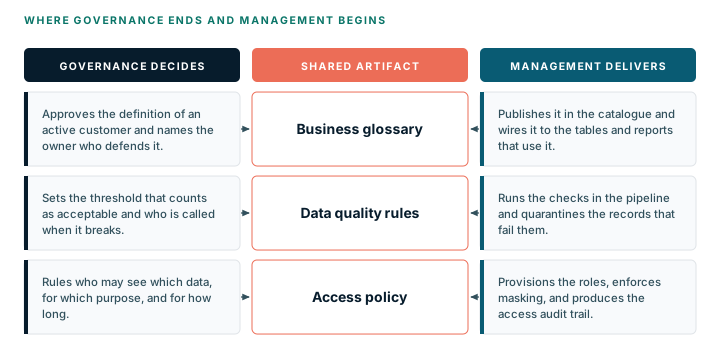
The business glossary is the clearest case. The definitions in it are governance decisions; the tool holding them, its integrations, and its refresh schedule are management responsibilities. When a glossary rots, the usual cause is that one side assumed the other owned it.
Data quality is the same story told twice. Setting the tolerance — 98% completeness on this attribute, measured weekly, and here is who accepts the risk when we miss it — is a governance act. Building the data quality rule, running the profiling, routing the alert, and fixing the pipeline is management. A quality program with rules but no accepted tolerances produces dashboards nobody acts on. One with tolerances but no rules produces opinions.
Classification runs the same way: the tiers and their handling requirements are policy, the tagging and enforcement are engineering. Write down for each of these three artifacts which half your organization owns and who owns the other half. The gaps you find in that exercise are usually the reason the artifact is not working.
Where to start
Start with governance, but only just enough of it. Name owners for the three domains that appear most often in your escalations. Write down the ten decisions those owners are allowed to make. Then hand that list to your data management function as a specification, because a management team that knows who decides can build controls that hold, and one that does not will keep inventing rules by default.
The two disciplines are not competing for the same ground. Governance without management is theory; management without governance is expensive improvisation. You need the pair, and you need to stop funding one while blaming the other.
If you want the next level of detail on the governance side, Building a Data Governance Operating Model shows how decision rights become working routines, and What Data Governance Is and What It Is Not clears out the assumptions that most often distort the design.