
Most failed governance programs I have been asked to rescue did not fail on execution. They failed on definition. Somebody in the room believed governance was a platform, somebody else believed it was a compliance exercise, a third person believed it was a project with an end date, and the program was funded on the average of those beliefs. Eighteen months later there was a tool, a policy library, and no change in how anyone made decisions.
So it is worth being precise, and precision here means saying what governance is not as carefully as what it is. A definition that only expands is useless: if governance includes everything, no one can tell whether they are doing it.
What data governance is
Data governance is the exercise of authority over data: deciding who may decide what, on what evidence, and who answers for the result. It has four working parts.
Rules with a scope
Governance produces data policies and data standards — statements that hold whether or not anyone is watching. Sensitive attributes are classified and handled accordingly. Retention has a period and a trigger. Naming has a convention. The definition of a business term has one approved form, held in a business glossary, and reports that use the term are expected to match it.
The useful test of a rule is whether you could tell, from evidence, that it had been broken. "We value data quality" is not a rule. "Customer email is mandatory on active accounts, measured weekly, and the domain owner accepts any month below 98%" is one.
Accountability with names on it
Governance assigns a data owner per data domain — an accountable individual, not a committee — and supports them with data stewards who do the definitional and quality work day to day. Custodians in the technical teams hold the storage and controls.
The word that matters is individual. Ownership spread across a forum is ownership nobody feels.
A place where disagreements end
Two teams will define "active customer" differently and both will be right for their purpose. Governance provides the forum — a data governance council or equivalent — where that gets resolved with a decision, a date, and a record, rather than escalated until someone tires.
The record is the part that does the work. Most definitional arguments in large organizations are the same argument recurring, because the previous resolution was made in a meeting and never written anywhere a newcomer would find it. A decision log with ten entries prevents more rework than a policy set with a hundred pages.
A practice, not a state
Definitions drift, systems change, regulation moves, and every organizational restructure orphans a set of owners. Governance is the routine that notices. That means a review cadence, decision rights that get revisited, and controls that are retired when they stop earning their keep.
Misconception 1: governance is something you buy
This is the expensive one. Catalogs, quality engines, and lineage tools are genuinely useful — they make governance decisions visible, enforceable, and cheap to check. What they cannot do is make the decision.
A data catalog will happily hold four competing definitions of "revenue" with no complaint. The tool has no opinion on which is correct, and no authority to make one binding. When a governance program starts with a procurement exercise, what usually ships is an empty catalog and a slow realization that populating it requires the exact conversations the tool was bought to avoid.
There is a reliable tell for this failure. Ask what percentage of the assets in the catalog have both an owner and an approved definition. Under a well-run governance function the number is small but rising, and someone can tell you which domains are covered. Under a tool-first program the number is unknown, and the honest answer is that the crawler populated the inventory and nobody has been through it since.
Buy the tool second. Decide who decides first.
Misconception 2: it is a project that finishes
Programs are scoped, funded, delivered, and closed. Governance behaves like operations: it has a run cost, a rota, and a backlog that never empties. Treating it as a project produces a predictable arc — a charter, a burst of activity, a completion report, and a quiet decay as the owners it named move roles and nobody replaces them.
I have seen the completion report land while the underlying problem was untouched: eleven policies approved, a council constituted, a catalog deployed — and the finance and commercial teams still bringing different revenue figures to the same monthly review, because no policy had ever named who arbitrates that. The project finished. The governance had not started.
The version that survives has a permanent home and a small standing budget. It also has an exit criterion for individual controls rather than for the whole function: each control has an owner and a review date, and at review it either justifies itself with evidence or is removed. That habit is what keeps governance from silting up into the bureaucracy everyone complains about.
Misconception 3: it is another word for data management
Governance decides; data management builds and runs. The classification policy is governance, the encryption and access configuration is management. The quality tolerance is governance, the data quality rule and the alert routing are management.
Conflating them causes a specific, common failure: governance gets funded inside IT, staffed with engineers, and asked to produce authority it does not have. Engineers can implement any rule you give them. They cannot make the head of finance accept a definition, and asking them to is how "governance" acquires its reputation as an obstacle. If the boundary is unclear in your organization, Data Governance vs Data Management works through it in detail.
Misconception 4: it exists to reduce risk
Risk and compliance are the easiest way to fund governance, which is why so many programs are framed that way — and the framing quietly caps the value.
A governance function judged only on risk optimizes for control coverage. It adds approvals, because an approval is auditable. It never removes any, because removal creates exposure with no matching credit. The result is a function that is safe, slow, and resented, and the first thing cut when budgets tighten.
The programs that last also measure the enabling side: how long it takes to get access to a dataset, how many certified metrics are reused rather than rebuilt, how much manual reconciliation has been eliminated, how quickly a new data product can be launched with ownership and quality in place. Those numbers are harder to collect and they are the reason anyone outside audit cares. If you have never put a figure on the operational drag, the cost of bad data calculator is a reasonable first estimate.
Misconception 5: it can be added afterward
Governance retrofitted onto a live estate is not the same work as governance designed in, and it costs several times more. Ownership assigned after a warehouse is built means reverse-engineering intent from SQL. Classification applied after ingestion means a discovery project across systems that were never labeled. Definitions agreed after twelve dashboards exist means a migration, not a decision.
The lightweight version at the start is genuinely cheap: an owner and a classification before a dataset gets a slot in the roadmap, a definition of done that includes a quality threshold and an alert route, and a named decider for the handful of questions the organization keeps stalling on. None of that requires a platform or a council. It requires the discipline to ask three questions before the build rather than after it.
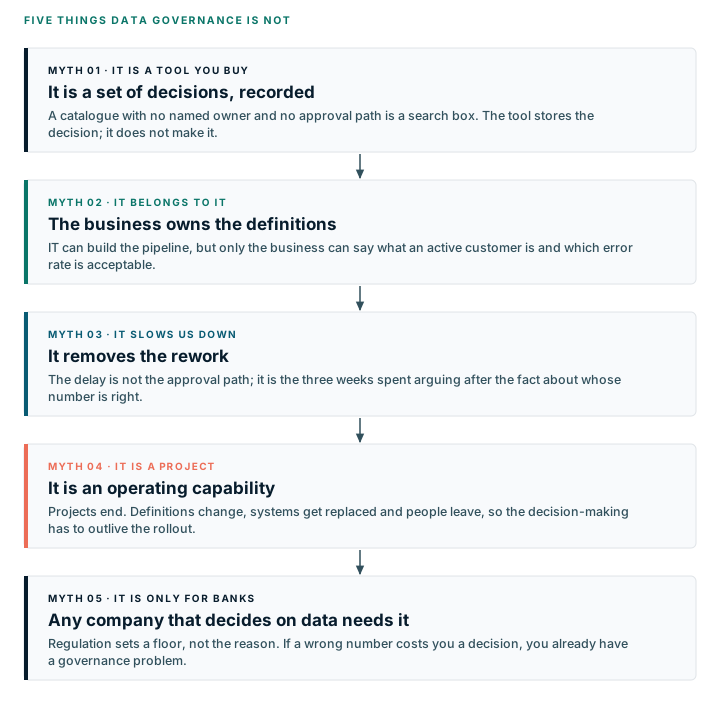
The five myths, side by side
| It is not | Because | What it actually is |
|---|---|---|
| A tool you buy | Software holds decisions; it cannot make them or enforce accountability | The authority that decides what the tool records |
| A project that finishes | Definitions drift, systems change, owners move on | An operating practice with a run cost and a review cadence |
| A synonym for data management | One produces rules and accountability, the other systems and operations | The decision layer that data management implements |
| Only about risk | Control-only governance adds approvals and never removes them | A function measured on both protection and enablement |
| Something to add later | Retrofitting means reverse-engineering intent from live systems | A small set of questions asked before the build |
What to do with this
If you are trying to get a governance program funded, or to explain why the last one did not work, the misconceptions above are usually where the disagreement actually sits. Getting a room to agree on what governance is not takes about an hour and saves the average program a year.
Then start small enough to be credible. Three domains with named owners, ten decisions written down, one forum with a real mandate, and a published measure of whether decisions are getting faster. That is a governance function. Everything else — the platform, the council structure, the maturity roadmap — is an elaboration you can afford once the basics are working.
If you want to see where your organization currently stands, the data governance maturity assessment covers the four dimensions that predict whether a program will hold. For the mechanics of turning these principles into working routines, Building a Data Governance Operating Model is the next step, and Introduction to the Basics of a Data Governance Program covers the foundations in order.