
In the world of enterprise Data Governance, buzzwords like "regulatory compliance," "data quality," and "cybersecurity" dominate strategic discussions. However, when it comes to executing governance practices that are operationally efficient, sustainable, and high-impact, two fundamental disciplines step into the spotlight: LEAN methodologies and Project Management.
Together, they form an agile, results-oriented framework for modern enterprise data management [DAMA International, DMBOK2].
While traditional governance initiatives often stall under the weight of bureaucratic paperwork and endless policy reviews, combining LEAN's relentless elimination of waste with Project Management's structured execution transforms data governance from a passive compliance exercise into an active business driver.
LEAN Methodologies: Eliminating Waste in Data Pipelines
Originating in modern manufacturing ecosystems (such as Toyota's Production System), LEAN focuses on a core philosophy: eliminating non-value-adding waste, optimizing process flow, and maximizing value delivery with minimal unnecessary effort.
When applied to enterprise data governance, LEAN challenges organizations to strip away redundant approvals, streamline data workflows, and ensure every governance policy directly serves a tangible business outcome [Gartner, Data Governance Framework].
- Raw Data
- Manual Approvals
- Duplicate Reconciliations
- Delayed Insight
- Raw Data
- Automated Quality Gates
- Single Source of Truth
- Immediate Value
The 3 Key LEAN Principles for Data Governance
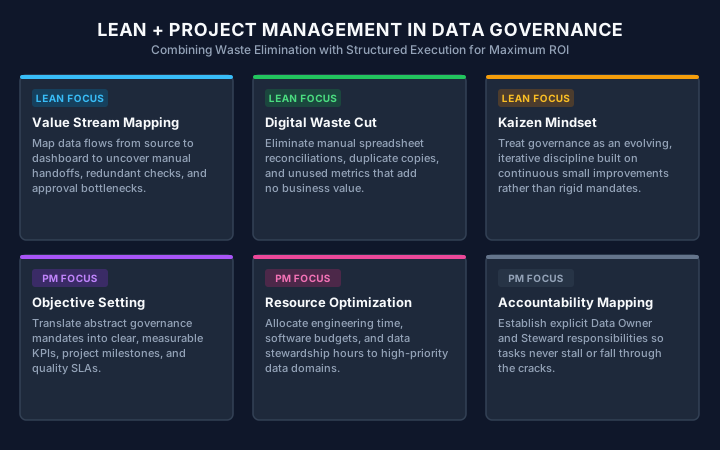
- Value Stream Mapping for Data: Trace data flows from initial ingestion to executive dashboards to identify manual handoffs, bottlenecked approval queues, and redundant data transformations.
- Elimination of Digital Waste: Identify and eliminate non-value-adding activities—such as manual spreadsheet reconciliations, ungoverned duplicate data copies, and unused reporting metrics.
- Continuous Process Improvement (Kaizen): Treat data governance as an iterative, evolving discipline that adapts through incremental operational enhancements rather than rigid, monolithic overhauls.
Project Management: The Engine of Governance Execution
If LEAN defines how processes should be optimized to eliminate waste, Project Management provides the structural framework of what, when, who, and at what cost.
Enterprise data governance programs are built through phased planning, cross-functional alignment, and disciplined execution [ED Council, DCAM v2]. Project Management supplies the roadmap required to transition governance from abstract strategic intent into operational reality.
Essential Project Management Pillars in Governance
- Clear Objective Setting: Translate broad governance mandates into specific, measurable Key Performance Indicators (KPIs) and Service Level Agreements (SLAs).
- Resource and Budget Optimization: Allocate engineering capacity, software tooling budgets (e.g., $50,000+ catalog investments), and domain Data Stewards to high-priority data assets.
- Agile Milestone Tracking: Utilize project frameworks (Gantt roadmaps, Kanban boards, sprint backlogs) to track governance rollout across domain teams.
- Accountability Mapping: Establish explicit ownership structures across business and technical stakeholders so tasks never stall.
LEAN + Project Management: A Winning Combination
The true strategic synergy occurs when LEAN methodologies and Project Management operate in tandem. LEAN ensures that data workflows are lean, fast, and value-driven, while Project Management supplies the organizational structure and accountability needed to execute those improvements predictably.
| Governance Dimension | LEAN Contribution | Project Management Contribution | Combined Strategic Impact |
|---|---|---|---|
| Workflow Design | Removes redundant approval steps and manual re-entry. | Defines clear implementation tasks, milestones, and deadlines. | Rapid, waste-free pipeline deployment. |
| Resource Allocation | Eliminates low-value reporting tasks and shadow databases. | Assigns named Data Owners and Stewards with clear scope. | Maximized ROI on engineering and staff hours. |
| Quality Management | Implements root-cause analysis (5 Whys) for data defects. | Schedules regular audit cycles and quality remediation projects. | Continuous, systematic data quality improvement. |
| Organizational Adoption | Focuses on user-centric, frictionless process design. | Manages communication plans, training, and change milestones. | High employee adoption and cultural integration. |
Real-World Synergies: Omnichannel Inventory Governance
Consider a regional retail enterprise struggling with inconsistent inventory data across physical stores and its e-commerce platform.
The Problem
When a customer updated their shipping address or completed an in-store return, employees across inventory, billing, and logistics manually re-entered the transaction into separate, unlinked databases. This manual workflow led to mismatched stock counts, delayed order fulfillments, and high customer service overhead.
The LEAN + Project Management Solution
- Applying LEAN: The team mapped the inventory data value stream and identified that 40% of employee time was spent on manual data re-entry. They eliminated duplicate entry steps and designed a centralized master data management (MDM) update pipeline.
- Applying Project Management: A dedicated project manager created a phased rollout plan, establishing clear timelines for software integration, defining Data Owner accountabilities for logistics data, and coordinating staff training across all regional stores.
The Business Outcome
- Operational Efficiency: Eliminated duplicate data entry, saving over 1,200 hours of manual staff labor annually.
- Data Accuracy: Reduced inventory discrepancies between e-commerce and physical stores by 85%.
- Cost Reduction: Cut order cancellation rates due to stockouts, saving $180,000 in lost seasonal revenue.
Practical Implementation Steps for Growing Businesses
Following insights from data management literature [Templar, Get Governed], smaller and growing organizations often operate with tight resource constraints where process inefficiencies carry severe financial penalties.
To implement LEAN and Project Management effectively within your governance framework, follow this phased action plan:
Phase 1: Audit and Streamline (LEAN Focus)
- Map Your Core Data Flows: Identify repetitive manual tasks, spreadsheet handoffs, and data validation bottlenecks within your primary operational processes.
- Target Quick Wins: Focus on high-impact, low-complexity improvements—such as standardizing data entry formats for customer records or retiring unused legacy reports.
- Engage Frontline Users: Involve operational teams in identifying daily data friction points and designing streamlined workflows.
Phase 2: Structure and Execute (Project Management Focus)
- Build a Phased Roadmap: Break overarching governance goals into manageable, 90-day execution projects with explicit deliverables.
- Leverage Lightweight Tooling: Utilize accessible project tracking tools (e.g., Trello, Asana, Microsoft Planner) to maintain visibility over governance tasks and accountabilities.
- Maintain Cadence: Hold brief, regular check-in meetings with domain Data Stewards to track progress, resolve blockers, and celebrate milestone completions.
Continuous Improvement Is the Real Destination
Data governance is not a static project with a fixed end date—it is an ongoing operational capability. By pairing LEAN's focus on waste elimination with Project Management's structured execution, organizations of all sizes can build governance programs that are agile, cost-effective, and continuously aligned with business growth.
Ready to Evaluate Your Data Governance Foundation?
Is operational friction or lack of execution structure stalling your data governance initiatives? Take our quick diagnostic assessment to evaluate your capabilities across People, Process, Technology, and Data, and receive a tailored improvement roadmap.