
Data literacy is often launched as a course and measured by attendance. That approach can create awareness, but it rarely changes how decisions are made. Six weeks after the training window closes, the same manager is still exporting the same report into the same spreadsheet, and the same two teams are still bringing different revenue numbers to the same meeting.
The problem is not the content of the course. It is the assumption underneath it: that people use data badly because they do not know how, and that knowing how is enough. In practice, people use data badly because the environment makes the careless path easier than the careful one. Literacy work that does not change the environment is a training event with a certificate attached.
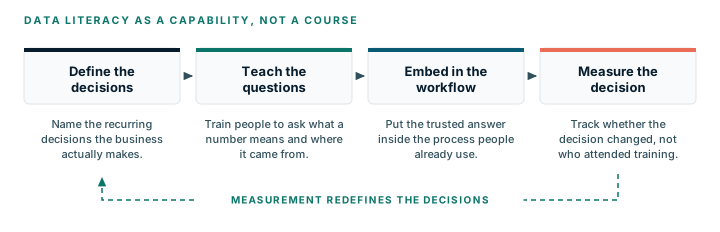
Treat it as a capability, not a curriculum
A capability is something an organization can reliably do. It has behaviors, the support that makes those behaviors possible, and evidence that they happen. A curriculum has modules and a completion rate. The difference shows up in how you plan the work.
Planning a curriculum starts with "what should people know". Planning a capability starts with "what decision is currently going badly, and what would have to be true for it to go well". That question tends to produce a much shorter list of skills and a much longer list of fixes to definitions, access, and tooling.
Define the behavior you need
Describe the specific decisions and workflows you want to improve, then define what good practice looks like in those moments. This makes the work concrete and measurable.
"Everyone should be data literate" cannot be acted on. These can:
- A category manager checks the certified margin metric before approving a promotion, rather than recalculating it in a spreadsheet.
- A campaign owner states the sample size and time window when presenting a test result.
- Anyone publishing a dashboard names an owner and a refresh cadence on it.
- A team that finds a discrepancy raises it against the metric's owner instead of quietly building a workaround.
Each of those is observable, and each one implies a support requirement: a certified metric has to exist, the test tooling has to expose sample size, the dashboard tool has to have an owner field, and the metric has to have a reachable owner. That is the honest cost of literacy work, and it is why it belongs next to your governance operating model rather than inside the learning function alone.
Create support at the moment of need
Provide definitions, examples, and guardrails inside the tools people already use. Support at the point of work is more effective than a course completed months earlier.
The moment of need is when someone is looking at a number and deciding whether to trust it. Whatever help exists has to be there, in that screen, at that second. Realistically that means four things:
- Definitions attached to the metric, not stored in a glossary nobody opens. If the dashboard says "active customers", hovering it should say what counts as active and who decided.
- Certification that is visible. A badge distinguishing a governed metric from an ad-hoc one lets people make a trust decision in a second instead of an hour.
- Worked examples in the local language of the team. Finance and marketing do not need the same example twice; they need their own once.
- A named person to ask. Not a ticket queue — a person, listed on the asset, who answers.
None of these are training. All of them raise the quality of decisions more than a course does, because they act on every decision rather than on the people who happened to attend.
Meet people where their confidence actually breaks
Literacy programs usually pitch at a general audience and miss both ends. Analysts sit through introductions to the mean; senior leaders get an SQL primer they will never use. Segmenting by what someone actually decides works better than segmenting by seniority.
Three practical audiences cover most organizations. Decision makers need to interrogate a number: where it came from, what it excludes, how confident to be. Producers — analysts, engineers, anyone building an asset — need shared standards for definitions, documentation, and publication. Everyday users need to find the right asset and know when it is not the right asset. Same program, three different asks.
Measure application
Track whether standard definitions are used, whether certified metrics replace ad-hoc extracts, and whether the number of conflicting reports goes down. These signals show real progress.
A small set of application metrics is enough, and each one should be readable from a system rather than from a survey:
| Signal | What it tells you |
|---|---|
| Share of decisions citing a certified metric | Whether governed assets are actually preferred |
| Number of active duplicate reports for the same question | Whether the environment still rewards workarounds |
| Time to resolve a definition dispute | Whether ownership is real and reachable |
| Proportion of dashboards with a named owner | Whether publication standards are holding |
| Repeat use of certified assets after 90 days | Whether adoption survived the launch push |
Compare these against a baseline you take before anything launches. Without a baseline, every result is an anecdote, and literacy programs are unusually prone to being judged by the enthusiasm of the people who liked them most.
Where it usually goes wrong
Three failure modes account for most stalled programs. The first is training people to use assets that do not exist yet — teaching a certified-metric habit before certification exists produces frustration, not literacy. The second is treating literacy as a communications campaign, where the deliverable is awareness rather than a changed workflow. The third is running it entirely inside HR or L&D, disconnected from the people who own the definitions, so that the standards taught in the course are not the standards the business enforces.
The fix in all three cases is the same: tie every literacy commitment to a specific decision, a specific asset, and a specific owner. If you cannot name all three, you are not building a capability yet.
If you want the argument for why this work outranks the control side of governance, Unlocking True Data-Driven Potential makes the case in more depth.