
If you work in data long enough, someone will hand you the DMBOK. It is a heavy book with a wheel on the cover, it is the closest thing the profession has to a shared vocabulary, and it is routinely misread — usually as a checklist to be completed rather than a reference to be consulted.
The DAMA Data Management Body of Knowledge is a body of knowledge, which is a specific and slightly awkward thing to be. It tells you what the discipline consists of, what good looks like in each part, and what vocabulary to use. It does not tell you what to do on Monday. Understanding that distinction is what separates people who get value from the DMBOK from people who spend a year producing artifacts nobody reads.
This piece covers what the framework says about data governance specifically, and how to use it without drowning in it.
How DMBOK defines data governance
The definition is short and worth reading twice:
The exercise of authority, control, and shared decision-making (planning, monitoring, and enforcement) over the management of data assets.
Three words in there do most of the work.
Authority means governance has the standing to make a decision stick. Without it you have a forum that issues recommendations, which is a very common and very expensive form of theater.
Shared means the decision-making is distributed rather than concentrated in IT or in a central team. Governance is a cross-functional act because the definitions and risk appetites it decides belong to the business.
Over the management of data assets is the part most often missed. Governance is not the management of data. It is authority exercised over that management. It sits above the work rather than doing it, which is exactly why it can be small.
Why governance sits at the center of the wheel
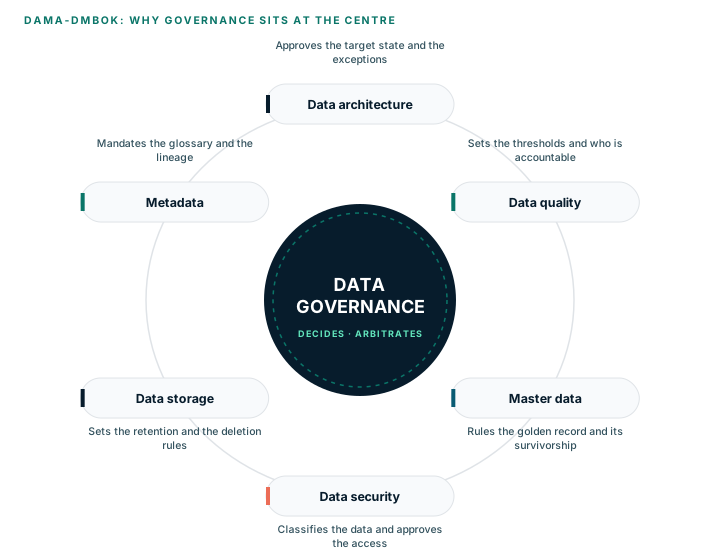
The DMBOK wheel puts data governance in the hub with the other knowledge areas around it — architecture, modeling, storage and operations, security, integration, documents and content, reference and master data, warehousing and business intelligence, metadata, and data quality.
Newcomers read the hub as a ranking: governance is the most important function. It is not a ranking, it is a topology. Governance is in the middle because every other area needs decisions it cannot make on its own authority. Security needs to know the classification tiers. Master data needs to know which system is authoritative for customer. Data quality needs to know the tolerance and who accepts the risk of missing it. Those are all governance outputs, consumed by other functions.
Read that way, the hub tells you something practical: if your governance function is producing artifacts that no other knowledge area consumes, it is not in the middle of anything.
The four components that make it work
DMBOK describes governance across a long chapter. In implementation it reduces to four components, and a program missing any one of them will stall.
Roles and responsibilities
The framework distinguishes roles that organizations habitually blur:
- Data owners are accountable for a data domain — they approve definitions, accept risk, and decide access. Senior enough to say no, close enough to the business to know what the data means.
- Data stewards do the definitional and quality work: maintaining the business glossary, investigating defects, coordinating fixes. This is where most of the actual hours go.
- Data custodians are the technical teams responsible for storage, controls, and operation. They implement; they do not decide.
The failure mode is a program with owners named on a slide and no stewards. Ownership without stewardship produces an accountable person with no capacity to act, and they will quietly stop attending.
Policies and standards
Data policies state what must be true; data standards state how. Classification, retention, privacy handling under GDPR, LGPD or HIPAA, access approval, naming conventions, and quality thresholds for critical data elements all live here.
DMBOK is clear that these should be few, findable, and enforceable. In practice, organizations write too many and locate them nowhere. A policy set is working when a steward can answer a live question from it in under a minute.
A note on how many policies are enough. Nine organizations out of ten I have worked with had more policy pages than they had stewards, which is a reliable sign that writing had substituted for deciding. If a policy has never been cited in a real decision and nobody can name its owner, it is documentation, not governance.
Decision bodies
The framework describes a data governance council or steering body — the forum where cross-domain conflicts get resolved and standards get approved.
One caution the book implies and practice makes obvious: councils review well and decide badly. Use the forum for arbitration, escalation, and approving standards. Keep routine decisions with named individuals, or your cycle time becomes the meeting cadence.
Oversight and monitoring
Governance without measurement drifts into assertion. Oversight means knowing what percentage of critical elements have active owners, whether quality is inside tolerance, how long access decisions take, and whether approved definitions are actually being reused. That reporting is what lets governance ask for continued funding with something other than principle.
Oversight is also how you find out that governance has stopped happening. The signal is rarely a dramatic failure; it is a slow decline in the ownership coverage number as people change roles, and nobody notices for two quarters because nobody was publishing it.
How governance directs the other knowledge areas
| Knowledge area | What governance supplies | What the area does with it |
|---|---|---|
| Data quality | Tolerances, critical element list, who accepts risk | Profiling, rules, monitoring, remediation |
| Data security | Classification tiers, handling rules, access policy | Encryption, role models, enforcement, audit |
| Data architecture | Domain boundaries, authoritative sources, standards | Models, integration patterns, platform design |
| Reference and master data | Which system is authoritative per entity | MDM matching, survivorship, distribution |
| Metadata | Definition approval, ownership records | Catalog population, lineage capture |
| Warehousing and BI | Certified metric definitions, retirement rules | Semantic models, certified reporting |
The pattern is consistent. Governance produces a decision; the knowledge area produces a system that implements it. Nothing in the middle column requires a platform, and nothing in the right-hand column can be resolved by a meeting.
What DMBOK will not give you
This is where most implementations go wrong, so it is worth being blunt.
The DMBOK does not sequence the work. It presents eleven knowledge areas as peers, and an organization that tries to stand all eleven up at once will make visible progress in none of them. Sequencing is your judgment call, informed by where your escalations actually come from.
It does not size the function. Nothing in the book tells you whether you need two stewards or twenty, or whether to run centrally or federate. That depends on how many named individuals can genuinely give you a day a week, which is a capacity question, not a framework question.
And it does not give you a business case. The framework will not tell your CFO what poor data is costing. You have to build that number from your own rework hours, duplicate records, and reconciliation effort — the cost of bad data calculator is a workable starting estimate.
Using DMBOK without drowning in it
A practical approach, in the order I would run it.
Use the vocabulary immediately. Adopting DMBOK's terms for owner, steward, custodian, and critical data element costs nothing and eliminates a category of confusion in every subsequent conversation.
Then pick three knowledge areas, chosen by where your pain is rather than by book order. For most organizations the productive trio is data governance itself, data quality, and metadata — because ownership, measurement, and documented definitions reinforce each other and produce visible results inside a quarter.
Use the maturity content as a diagnostic, not a target. A data maturity model is useful for finding your weakest dimension and worthless as an ambition; "reach level 4" is not an outcome anyone outside the data team will fund. If you want a fast read on where you stand, the maturity assessment covers the dimensions that predict whether a program holds.
And consider the certification if you want the vocabulary properly. The CDMP examines the whole body of knowledge, and studying for it is the most efficient way to stop guessing which chapter answers a given question.
Governance as an iterative practice
The framework is explicit that this is continuous. Business models change, regulation moves, systems are replaced, and every restructure orphans a set of owners. A governance function that does not revisit its own decision rights, retire controls that stopped earning their place, and re-confirm ownership after each reorganization will decay whatever it achieved in year one.
That is the honest reading of DMBOK on data governance: a shared vocabulary, a description of what good looks like, and a clear statement that authority — not tooling, not documentation — is the thing that makes any of it work.
For the practical layer the book deliberately leaves open, Building a Data Governance Operating Model covers how decision rights turn into working routines, and Introduction to the Basics of a Data Governance Program sets out the foundations in the order I would build them.